(Some) Parents Stood Up for (Some) Children

This weekend, City Councilperson Robyn Wheatley posted a graphic on her Facebook page, celebrating the “Kids Not Camps” initiative that she helped pass, along with Mayor Bill Rosacker, in May 2023. Earlier this month, Rosacker also reminded voters that he worked hard to make car camping illegal near schools, part of his mayoral efforts to make Newberg safe again.

Here’s the thing: like their MAGA president, both candidates are returning to their greatest hits, rather than offering many new solutions to a town in need of change. And here’s another thing: the “Kids Not Camps” campaign demonized the houseless population in Newberg, and also vilified a Christian community trying to live faithfully into their Jesus-centered mission.  

So really, not an initiative to be proud of after all.

Let’s review what happened in 2022: North Valley Friends Church, a Christian congregation that has existed in Newberg for over 50 years, felt called by God to help those experiencing houselessness in Newberg, and proposed Peace Trail Village, a planned transitional housing project on the NVFC property consisting of eight small cottages, along with shared community and laundry facilities. The church was awarded $400,000 of American Rescue Plan Act (ARPA) money to help begin their work on the village. (You can find out more about that project here.) 

This was not a homeless shelter or sprawling encampment of unsupervised people. According to the ARPA proposal, funds would help vet those living in tiny homes, as well as providing wrap-around care for residents. The targeted clientele for these homes was people experiencing medical procedures to recover in a warm, safe space, rather than on the street or on a friend’s couch. Again, NVFC was following a faithful call from God in proposing this well-thought out, well-considered plan, including safeguards to assure that clients and neighbors were kept safe.

Some parents at Veritas School were upset about the thought of houseless people living so close to their school, and raised their objections, something that was well within their rights to do, because almost everyone–including NVFC, including those experiencing houselessness–cares about the safety of their children.

In summer 2022, there was a meeting between NVFC and Veritas to share information, hoping to quell concerns Veritas parents had about the proposed project. The meeting was advertised as only for direct stakeholders: NVFC members, and Veritas parents. Rather than make space for thoughtful listening, Rosacker (not a NVFC member or a Veritas parent) was at that meeting, clipboard in hand, ready with a Kids Not Camps petition. In other words, rather than taking time to listen to the church’s concerns (or even the parents’ concerns), Rosacker met the emotional moment, and parents’ fears, by having a petition ready for them to sign.

Even though the church’s proposal wasn’t about camping. Even though the church tried to reassure parents that their robust children’s ministry showed they cared about kids, too. Even though a Red Bucket Preschool representative spoke at the meeting, supporting the Peace Trail Village project, trusting that the church where their school was located would not put their kids in harms’ way.

Certainly it was acceptable for people to have concerns about the project, and to ask hard questions of North Valley Friends. Residents were entitled to wonder whether city money should support the project or whether it belonged in that location. The intent of the meeting between Veritas and NVFC offered one opportunity for those questions and concerns, though Rosacker already had his petition ready to go, exaggerating claims about what North Valley was doing, stoking fears in parents, dehumanizing those experiencing houselessness, and showing an astounding lack of charity to Christians trying to follow God’s call. 

That petition effort in summer 2022 led to both Rosacker’s and Wheatley’s election in November 2022; both rode into their positions on an emotionally powerful public safety issue. The “Kids not Camps” petition passed in May 2023. And now, three years later, both Rosacker and Wheatley are returning to this issue, seeing it as a “proud moment” when they listened to parents, and stood up for a community’s children.

Well, at least some parents. And some children. 

Make no mistake: this was also not necessarily a grassroots effort to protect Newberg, but a well-funded campaign by wealthy donors who chose to denigrate folks who were struggling. According to public records, the George family paid $26,693.36 to the Kids not Camps PAC, backing the efforts of Wheatley and Rosacker to assure that houseless people in Newberg would not be able to turn to a church for support. 

There’s an undercurrent of fear-mongering and disinformation that continues to fuel the “Kids Not Camps” rhetoric, evident even in the infographic Wheatley posted on her Facebook page. For example, the Peace Trail Village was not a “homeless shelter,” despite what Wheatley says in her post, which also advocates for “Parents” and “Community.” 

Again, some parents. And some community. But definitely not all.

Wheatley also wrote that “City Council should not be funding homelessness!” On this, perhaps, we can agree, because funds for a Peace Trail Village would have explicitly helped people to not be homeless. A win for them, and for our community. 

For a host of reasons, including the disinformation campaign targeting NVFC, Peace Trail Village will not be built. Those struggling to find housing in our community will need to seek out other, very limited resources. Still, what happened in 2022 should not be reason to celebrate now, in 2026, as Wheatley and Rosacker seem to be doing. 

Perhaps it’s still wise for Wheatley and Rosacker to raise this dark part of our community’s history, because they are really asking us this: what kind of leadership do we want in city hall? And, how do we want our community to conduct politics? 

When someone tells us our children are in danger, we should ask for evidence. 

When complicated issues are reduced to slogans, we should look behind the slogan.

When disinformation begins circulating around a legitimate community concern, we should expect leaders to correct it—even when that disinformation might help their political cause. This was the case when disinformation demonized a church congregation, suggesting someone that North Valley wanted to harm children; and also dehumanized houseless people, seeking safety and a place to call home. Rather than asking that the purveyors of disinformation stop telling lies about Newberg citizens, Rosacker allowed their efforts to continue, suggesting that he doesn’t really work for all of Newberg’s citizens, after all.

When someone asks for our vote, we should look not only at what they’re telling us today, but at what they’ve told us before.

Newberg will undoubtedly face difficult decisions in the coming years: water rates, infrastructure, housing, economic development, public safety and how we pay for all of it. There will be honest disagreements about those issues. But disagreement doesn’t require fear, nor do they mean demonizing people in our community who are struggling with houselessness–or who are seeking creative ways to provide homes. 

Four years ago, Newberg was given one particularly memorable slogan: Kids Not Camps.

This election year, voters have the benefit of something they didn’t have then. Four years of hindsight. We should use this hindsight by voting for Elise Yarnell Hollamon. 
Data Centers and the Future of Newberg’s Mill Property

Data centers are universally unpopular. According to recent reporting by the New York Times, nearly three in four Americans oppose the construction of data centers in their communities, especially if those centers–and more broadly, artificial intelligence–remain unregulated.

As more government leaders realize that unfettered creation of data centers is an unpopular issue, they have gone mostly silent on building data centers in the communities they serve. In other words, some folks were for data centers, until they were against them. 

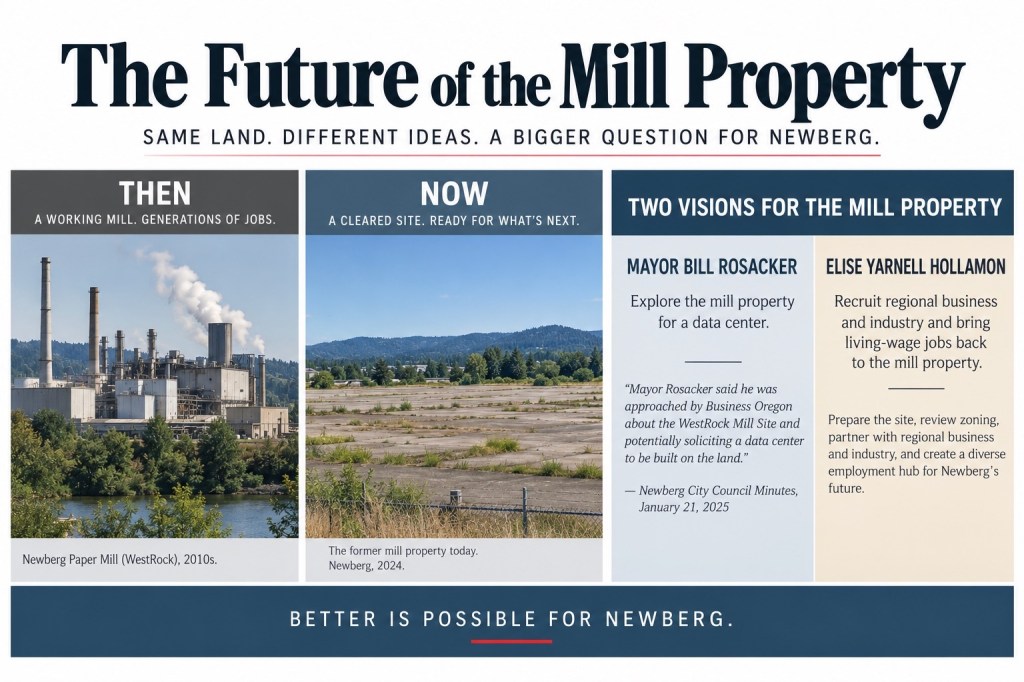
This includes current Newberg mayor Bill Rosacker. In a long Facebook post published in  February 2025, Rosacker wrote that he was “somewhat supportive of a small server farm (<20 acres)” on the WestRock mill property in south Newberg. Rosacker argued a server farm could provide several well-paying jobs and a significant tax base while requiring fewer employees to travel to and from the data center site. He also specifically referenced the property’s access to electricity, the Willamette River, water rights and potentially treated wastewater as reasons Newberg could accommodate such a use.

And, just last month, Newsberg reported that Rosacker was appointed to the Environmental Protection Agency’s (EPA) Local Advisory Committee, a group of local and state officials who advise the agency on environmental issues affecting local governments. The committee will begin its new charter by discussing the challenges local governments face in the sustainable siting and development of AI infrastructure and data centers. While this does not mean Rosacker was appointed because of his views on data centers, it does make his February 2025 comments particularly relevant as Newberg discusses the future of its own industrial land. 

Surely Rosacker recognizes the unpopularity of data centers in Newberg, and the community’s general resistance to having them planted at the mill site. Because it’s clear that Newberg also does not want a data center built here. Why else would petitioners for a Rural Heritage Park ordinance use data centers as an enticement to gain signatories? 

As the political action committee Share Our Parks organization pointed out in an July 31 Facebook post, the petitioners for a Rural Heritage Park ordinance were misleading others. Petitioners, text messages, and signage suggested a bill would assure that data centers were permanently prohibited from Chehalem Park and Recreation District property. This obfuscated the real intent of the petition: to keep bike riders from using trails at Crystal Rilee Park, raising questions about whether a small group of people should make decisions about publicly-funded, publicly-maintained properties. 

The messaging from Rosacker about data centers is muddled, perhaps because they are so unpopular, and because he was for data centers, until nearly everyone else was against them. These are policy questions he should more readily answer: Does he still support placing a data center of up to approximately 20 acres on the former mill property? And, given his new federal advisory role, how should communities like Newberg balance data-center development against water use, energy demand, industrial-land scarcity, employment generation and neighboring residential areas?

Rosacker’s opponent, Elise Yarnell Hollamon, is offering a different, far more transparent and compelling position. She acknowledges that data centers are part of the infrastructure supporting modern technology, but does not support placing one within Newberg or rural Newberg. Our community’s limited industrial and employment land should instead be prioritized for uses that generate substantial numbers of living-wage jobs and contribute to a vibrant riverfront and mill district.

“Data centers are an inevitable part of modern life,” Hollamon told us. “Every day, we rely on technology that requires this infrastructure, and pretending otherwise isn’t realistic. What is realistic is being thoughtful about where data centers belong and scrutinizing their impact on the communities where they’re proposed. I do not support a data center within Newberg’s city limits or rural Newberg.”

Hollamon has a mill strategy that begins with bringing the property back online and developing it as competitive employment land. She proposes revisiting and revitalizing the Riverfront Master Plan, directing eligible Urban Renewal resources toward infrastructure and predevelopment barriers at the former mill, and building a direct working relationship with the private property owner so Newberg has an active seat at the table as the site’s future is determined.

For Hollamon, the mill is fundamentally an affordability and economic-development issue. Newberg has lost significant manufacturing employment, and the former mill represents one of the community’s most consequential opportunities to recruit new employers. Her argument is that public economic-development tools should be used intentionally to lower the barriers preventing private investment, rather than waiting for the market to determine the future of the riverfront without meaningful city involvement.

Her plan also considers River Street and its thriving as an established residential neighborhood. While River Street residents are already navigating significant questions surrounding road reconstruction, Hollamon argues that the ultimate use of the mill should account for traffic, neighborhood impacts, the riverfront and the city’s broader economic-development goals—not simply tax-base generation.

Fundamentally, in our efforts to build a better community, we believe that thoughtful planning is necessary, rather than ready capitulation to tech companies looking for cheap land and energy to build their data farms. 

This is why Newberg Neighbors is supporting Elise Yarnell Hollamon: someone who is for all of Newberg, not just the privileged few. We believe Better is Possible for Newberg.

We, Not Me: Elise for Mayor of Newberg

Our Newberg neighbors are tired. 

Tired of the partisan bickering, for sure, but also weary of an affordability crisis that has beset our hometown. Water bills are too high, and the lack of jobs that pay a sustainable wage means that too many people are struggling to make ends meet. We’re also tired of feeling like our voices don’t matter at city hall, and that our local government isn’t always listening to our concerns.

That’s why Newberg Neighbors for a Better Community was excited to hear that Elise Yarnell Hollaman is running for Newberg mayor, and will take on incumbent Bill Rothsaker in November’s election. Elise has served on the Newberg City Council since 2018, understands our community well, and will work hard to assure that Newberg truly is a great place for everyone to thrive. 

Her campaign is focused on the idea of “We, Not Me,” a promise that intends to end partisanship in city hall. By promoting collaboration, Elise will also assure that everyone in Newberg has a seat at the decision-making table, even if they don’t always agree on the decisions being made. This is truly what leadership is about: drawing together different stakeholders and allowing them to be heard, as well as embracing difference as a strength that will lead to better decisions for all.

Elise’s promises are grounded in several specific efforts that will move Newberg forward:

Lowering Water Bills: Newberg households have some of the highest water bills state wide, and paying so much for water can be crushing for many families. Newberg families need more than incremental reductions in their water bills. 

We need to pursue structural changes that can actually bring costs down.

As mayor, Elise will initiate conversations with Dundee and Dayton about creating a regional approach to water infrastructure, including exploring a regional water district and shared treatment infrastructure.

Working regionally could allow our communities to pursue state and federal infrastructure funding together, share major capital costs, and strengthen our competitiveness for limited infrastructure dollars.

Her goal is simple: pursue every viable option capable of meaningfully lowering the cost of water for Newberg families.

Bring back jobs: Newberg cannot afford to keep watching employers and living-wage jobs leave our community. For years, the city government talked about economic development while major employment properties have remained difficult to develop.

It’s time to move from talking about jobs to preparing land for them.

Available urban renewal resources are tools that can be prioritized in a way to support job growth. Elise will push to remove infrastructure and predevelopment barriers that are preventing key employment land—including the former mill property by the river—from becoming development-ready.

Then she will lead an initiative to recruit manufacturing, technology, and trade-sector businesses to create careers here, in Newberg, allowing people to raise their families and build a future here. 

Her goal is simple: Elise will do everything to prepare land, compete for employers, and bring living-wage jobs back to Newberg.

Listen to Everyone: Newberg has spent too much time fighting national culture wars at the local level while the work directly affecting people’s daily lives waits for our attention. 

We can all agree that it’s time for our local government to solve problems, not pick sides.  

Disagreements are a gift, and can make the government better when leaders are willing to listen and learn from each other–and from the constituents they serve. Collaboration isn’t a dirty word, but an opportunity to recognize that no political party, ideology, neighborhood, or individual has a monopoly on good ideas–and then work together to improve the lives of everyone

As mayor, Elise promises to protect space for disagreement, expect respectful leadership from the Council, and make sure people know they can participate in their city government regardless of their politics.

Her goal is simple: Elise will focus on common ground between different stakeholders, because common ground is common sense, and local leadership works best when everyone is invited to the decision-making table. 

Over the next few months, Newberg Neighbors will be working hard to help elect Elise, because we love our community and want it to thrive, and because we believe Elise offers the best opportunity to move Newberg forward. We hope you’ll join us in these efforts. Stay tuned for specific ways you can help make Newberg a better community.

Blog at WordPress.com.

Up ↑