
Pack City Hall on October 5

Newberg supports its immigrant neighbors.

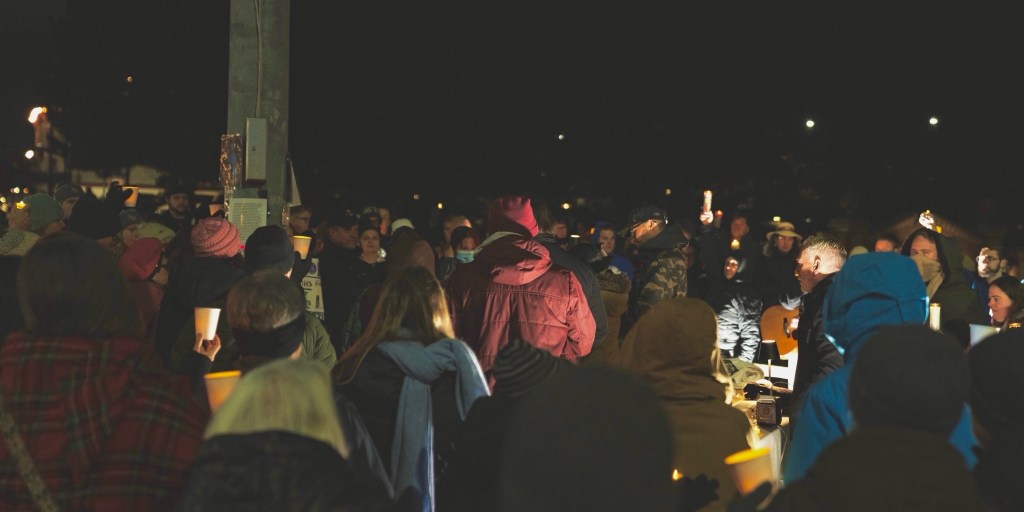
That’s the message we hope to share at the October 5 Pack City Hall event, and we would love for you to join us.

Fundamentally, we want this to be a respectful and peaceful event, free of violence of any kind. We are asking that the mayor and councilors listen and learn. We are committed to doing our part to maintain a respectful, peaceful environment and to avoid confrontation, hostility or anything that could escalate tensions.

We simply want to bear witness to those who have suffered so much in our community and who deserve our love and support. This is one small, simple way we can “pray with our feet” by standing in solidarity with people who may be too afraid– or simply unwilling –to put themselves in potentially hostile environments.

We have all seen the ways our neighbors have been terrorized and made to fear for their safety in a community where they should feel secure. Under the banner of “immigration enforcement,” our neighbors no longer feel safe to work, shop, send their children to school, or attend church. There is legitimate fear and heartache running through our community. 

Many fear being deported, or being sent to countries where they have never lived, detained in inhumane conditions, or harmed by enforcement actions. There are also painful reverberations from the trauma of having fathers and mothers, sons and daughters, picked up and effectively “disappeared.”

The Pack City Hall event is our chance to say: Enough. Enough of the violence. Enough of the dehumanizing treatment. Enough of the targeted hate. We’ve also had enough of city leaders choosing silence while their constituents live in fear. 

Here’s what you need to know

  • When: Monday, October 5, at 5:40 p.m.
  • Where: Gather in front of the Newberg City Public Safety building before the city council meeting. 401 E 3rd St, Newberg.
  • Each participant will receive a picture of an immigrant who has been harmed by ICE, including images of 12 Yamhill County residents who have been detained and 77 people nationwide who have died in connection with ICE activity.
  • During the council meeting, we will quietly and respectfully hold our signs and listen to the public comments. A few planned comments will be made to the council, including comments from representatives of UNIDOS. It’s public comment time, so there may be other comments.
  • After the public comments, we will leave the city council chambers as quietly as possible, then walk to the flagpole for a vigil.
  • We have a beautiful banner for the front of our group, designed by a local resident. It reads:

“Caminamos en Solidaridad con Nuestros Vecinos” “We Walk in Solidarity with Our Neighbors”

  • Friendsview residents: Transportation will be available from Friendsview to the council meeting, from the meeting to the flagpole, and back to Friendsview. If you would like a ride, meet at the main entrance at 5:30 p.m.
  • Lawn chairs will be available at the flagpole for those who need to sit.
  • Wear yellow! Yellow signifies our solidarity with our immigrant neighbors.
  • It will be dark at the flagpole and potentially cold, so please dress accordingly.
  • There will be a guest speaker at the flagpole. We will read the names of people who have died in connection with ICE activity over the past two years. We will end by honoring and sharing information about Yamhill County residents who have been detained by ICE. Tealight candles will be available for everyone.

Please help keep the event peaceful

Because of safety concerns, some volunteers will be providing security for the event. There may also be people at the council meeting or the flagpole who disagree with our message and may try to provoke conflict.

Please do not take the bait. If someone attempts to provoke you, remain calm, disengage, and allow security volunteers to address the situation.

Our goal is to stand together peacefully and respectfully in solidarity with our immigrant neighbors. 

Please join us at this important event.
Data Centers and the Future of Newberg’s Mill Property

Data centers are universally unpopular. According to recent reporting by the New York Times, nearly three in four Americans oppose the construction of data centers in their communities, especially if those centers–and more broadly, artificial intelligence–remain unregulated.

As more government leaders realize that unfettered creation of data centers is an unpopular issue, they have gone mostly silent on building data centers in the communities they serve. In other words, some folks were for data centers, until they were against them. 

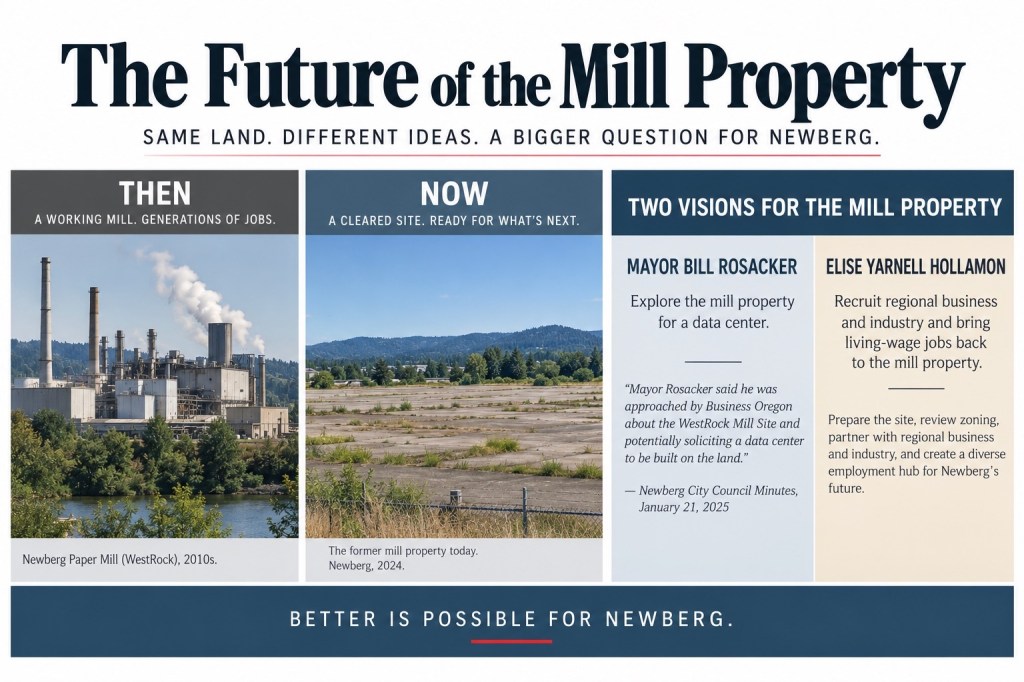
This includes current Newberg mayor Bill Rosacker. In a long Facebook post published in  February 2025, Rosacker wrote that he was “somewhat supportive of a small server farm (<20 acres)” on the WestRock mill property in south Newberg. Rosacker argued a server farm could provide several well-paying jobs and a significant tax base while requiring fewer employees to travel to and from the data center site. He also specifically referenced the property’s access to electricity, the Willamette River, water rights and potentially treated wastewater as reasons Newberg could accommodate such a use.

And, just last month, Newsberg reported that Rosacker was appointed to the Environmental Protection Agency’s (EPA) Local Advisory Committee, a group of local and state officials who advise the agency on environmental issues affecting local governments. The committee will begin its new charter by discussing the challenges local governments face in the sustainable siting and development of AI infrastructure and data centers. While this does not mean Rosacker was appointed because of his views on data centers, it does make his February 2025 comments particularly relevant as Newberg discusses the future of its own industrial land. 

Surely Rosacker recognizes the unpopularity of data centers in Newberg, and the community’s general resistance to having them planted at the mill site. Because it’s clear that Newberg also does not want a data center built here. Why else would petitioners for a Rural Heritage Park ordinance use data centers as an enticement to gain signatories? 

As the political action committee Share Our Parks organization pointed out in an July 31 Facebook post, the petitioners for a Rural Heritage Park ordinance were misleading others. Petitioners, text messages, and signage suggested a bill would assure that data centers were permanently prohibited from Chehalem Park and Recreation District property. This obfuscated the real intent of the petition: to keep bike riders from using trails at Crystal Rilee Park, raising questions about whether a small group of people should make decisions about publicly-funded, publicly-maintained properties. 

The messaging from Rosacker about data centers is muddled, perhaps because they are so unpopular, and because he was for data centers, until nearly everyone else was against them. These are policy questions he should more readily answer: Does he still support placing a data center of up to approximately 20 acres on the former mill property? And, given his new federal advisory role, how should communities like Newberg balance data-center development against water use, energy demand, industrial-land scarcity, employment generation and neighboring residential areas?

Rosacker’s opponent, Elise Yarnell Hollamon, is offering a different, far more transparent and compelling position. She acknowledges that data centers are part of the infrastructure supporting modern technology, but does not support placing one within Newberg or rural Newberg. Our community’s limited industrial and employment land should instead be prioritized for uses that generate substantial numbers of living-wage jobs and contribute to a vibrant riverfront and mill district.

“Data centers are an inevitable part of modern life,” Hollamon told us. “Every day, we rely on technology that requires this infrastructure, and pretending otherwise isn’t realistic. What is realistic is being thoughtful about where data centers belong and scrutinizing their impact on the communities where they’re proposed. I do not support a data center within Newberg’s city limits or rural Newberg.”

Hollamon has a mill strategy that begins with bringing the property back online and developing it as competitive employment land. She proposes revisiting and revitalizing the Riverfront Master Plan, directing eligible Urban Renewal resources toward infrastructure and predevelopment barriers at the former mill, and building a direct working relationship with the private property owner so Newberg has an active seat at the table as the site’s future is determined.

For Hollamon, the mill is fundamentally an affordability and economic-development issue. Newberg has lost significant manufacturing employment, and the former mill represents one of the community’s most consequential opportunities to recruit new employers. Her argument is that public economic-development tools should be used intentionally to lower the barriers preventing private investment, rather than waiting for the market to determine the future of the riverfront without meaningful city involvement.

Her plan also considers River Street and its thriving as an established residential neighborhood. While River Street residents are already navigating significant questions surrounding road reconstruction, Hollamon argues that the ultimate use of the mill should account for traffic, neighborhood impacts, the riverfront and the city’s broader economic-development goals—not simply tax-base generation.

Fundamentally, in our efforts to build a better community, we believe that thoughtful planning is necessary, rather than ready capitulation to tech companies looking for cheap land and energy to build their data farms. 

This is why Newberg Neighbors is supporting Elise Yarnell Hollamon: someone who is for all of Newberg, not just the privileged few. We believe Better is Possible for Newberg.

Standing in Solidarity with Our Neighbors

People in our community, our Newberg neighbors, are being picked up by immigration enforcement without warrants, detained without charges, and often sent out of state, leaving families and friends in the dark about their whereabouts.

Some call these immigration actions what they are: kidnappings. Many of our city officials seem to shrug, saying little to nothing about the people they’ve been voted to represent. An entire community is living with fear, their lives on hold because of ICE, and Newberg city officials don’t want to address the trauma being perpetuated by rogue immigration enforcement.

This is unacceptable. 

On October 5 and in conjunction with UNIDOS, we are hosting a Pack Newberg City Council event, hoping to call attention to our neighbors’ pain and to our city government’s inaction. We want to stand in solidarity with immigrants who have made Newberg home, and who are being dehumanized by ICE actions–and our local government’s inaction.

If you can participate, please gather in front of city hall before the city council meeting on Monday, October 5, at 5:40 p.m. Each participant in our event will receive a picture of an immigrant who has been harmed by ICE, including the images of 15 Yamhill County residents who have been detained, and 55 people (nationwide) who have died because of ICE activity.

We plan to hold the signs during the city council meeting to humanize a dehumanizing process, putting names and faces to the immigrants impacted by ICE kidnappings. After making statements during public comments at the council meeting, we will march from city hall to the flag pole, where we will hold a vigil for local and national victims of ICE.

Standing in Solidarity with our neighbors will convey to our elected officials that they cannot be silent about the harmful effects of unfettered immigration enforcement. Standing in solidarity with our neighbors will hopefully convey that we are mourning with those immigrants who are themselves grieving the loss of family members to ICE raids, as well as the loss of safety and security.

We hope you will join us in supporting folks who are our neighbors and friends, and who deserve to know that Newberg is a place they can call home.

____________________________________________________

Let us know if you are willing to hold a sign! We need 60+ people, and it would help us a lot if you would let us know you are planning to be there and participate. We can even assign you the person’s sign you will carry ahead of the event. Please use this link to indicate your interest: https://forms.gle/C3GFNrujHXrg3yHi6

Better is Possible

Over the past few years, our site has been committed to the vision that a better community is possible when we work together to assure that Newberg is a place where everyone can thrive. That simple premise has seemed so challenging, which is probably why we are excited about Elise Yarnell Hollamon’s campaign for mayor and her assurance that Better is Possible when our city leaders work for all of Newberg. 

A recent Newsberg candidates’ questionnaire asked mayoral and city council candidates the same three questions, and published their unedited answers in full. The responses from Elise, as well as city council candidates Larry Hampton and Leisha Adams, share some important common ground:

  Affordability matters.

The cost of city services matters.

Newberg needs to solve these challenges.

Elise identifies affordability as Newberg’s most pressing issue, and has a clear, common sense solution to lessen the burden of city costs on Newberg’s citizens. Her innovative idea would bring Dundee, Dayton, and regional partners together around long-term water infrastructure with the goal of significantly reducing water rates without raising taxes. 

She also believes that bringing living-wage jobs back to Newberg is possible if the city can get key employment land—particularly the former mill property—back online, rather than focusing on efforts to bring a data center to the area. 

Fundamentally, Elise is driven by the conviction that the tone of leadership at Newberg City Hall needs to change, so that respect and genuine consideration for different perspectives is once again part of how decisions get made. Electing Larry and Leisha for city council, alongside Elise for mayor, will help achieve these goals. 

Larry also identifies affordability as the most pressing issue, connecting it to housing, utilities, living-wage jobs and the costs of development. He supports pursuing partnerships with neighboring communities for more affordable and sustainable utilities, expanding industrial and commercial opportunities, and developing the former mill property. He also says he wants residents to know that he intends to listen well to community needs, and adjust his approach when necessary. 

Leisha brings her professional experience managing and auditing nonprofits and her current work as a Yamhill County finance analyst to the conversation. She focuses specifically on water costs, asking how Newberg can reduce what residents pay while still maintaining necessary infrastructure, and points toward growing the number of customers sharing those costs. 

The Newsberg article provides only an outline of Elise’s vision for making Newberg a better place for everyone to thrive. 

So here’s a little spoiler: there’s a lot more detail to come. In the coming weeks, we’re excited to share the details behind how Elise proposes significantly reducing water rates without raising taxes, how Newberg can bring living-wage jobs back, and how considering all voices becomes something leadership actually does—not simply something candidates say.

And a second spoiler: Bill’s lack of initiative on the mill site over the last four years—and what appear to be his plans in the coming days—are concerning. The contrast with Elise’s vision for the future of that site is clear.

Want to support Elise, Larry, and Leisha as they fulfill their promise that Better is Possible? 

COME HEAR MORE AT THE CAMPAIGN KICKOFF!

📅 Friday, September 4
⏰ 6:00–8:00 PM
📍 Newberg — RSVP for the location
📧 comms@livabilityoregon.org

We, Not Me: Elise for Mayor of Newberg

Our Newberg neighbors are tired. 

Tired of the partisan bickering, for sure, but also weary of an affordability crisis that has beset our hometown. Water bills are too high, and the lack of jobs that pay a sustainable wage means that too many people are struggling to make ends meet. We’re also tired of feeling like our voices don’t matter at city hall, and that our local government isn’t always listening to our concerns.

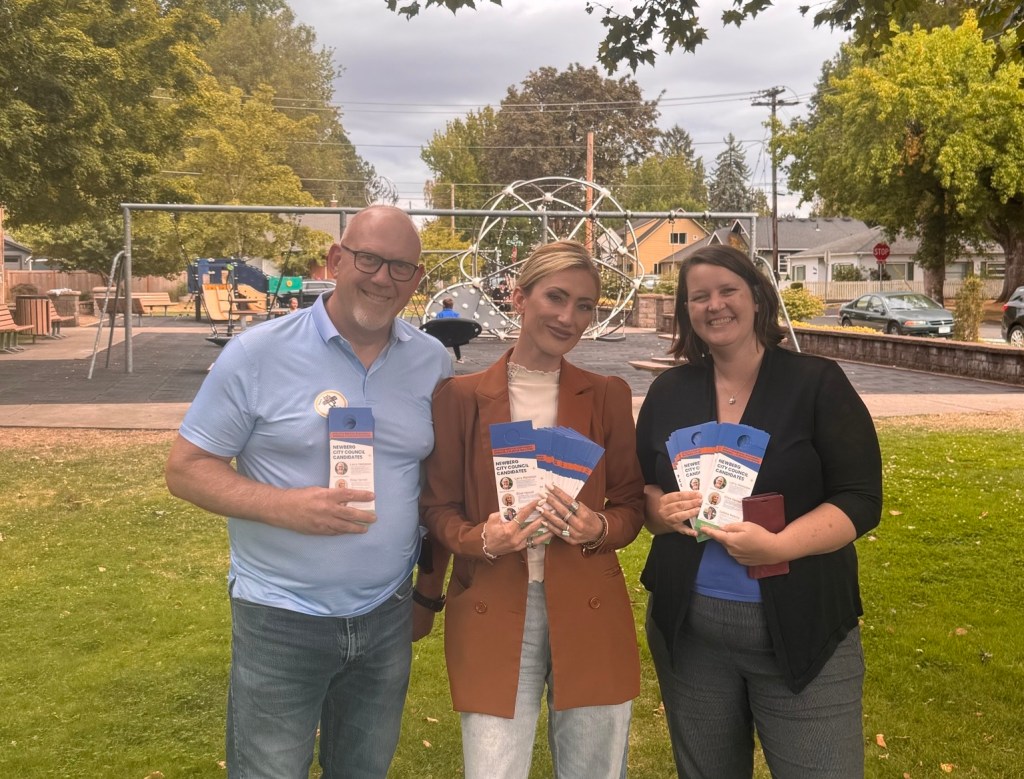
That’s why Newberg Neighbors for a Better Community was excited to hear that Elise Yarnell Hollaman is running for Newberg mayor, and will take on incumbent Bill Rothsaker in November’s election. Elise has served on the Newberg City Council since 2018, understands our community well, and will work hard to assure that Newberg truly is a great place for everyone to thrive. 

Her campaign is focused on the idea of “We, Not Me,” a promise that intends to end partisanship in city hall. By promoting collaboration, Elise will also assure that everyone in Newberg has a seat at the decision-making table, even if they don’t always agree on the decisions being made. This is truly what leadership is about: drawing together different stakeholders and allowing them to be heard, as well as embracing difference as a strength that will lead to better decisions for all.

Elise’s promises are grounded in several specific efforts that will move Newberg forward:

Lowering Water Bills: Newberg households have some of the highest water bills state wide, and paying so much for water can be crushing for many families. Newberg families need more than incremental reductions in their water bills. 

We need to pursue structural changes that can actually bring costs down.

As mayor, Elise will initiate conversations with Dundee and Dayton about creating a regional approach to water infrastructure, including exploring a regional water district and shared treatment infrastructure.

Working regionally could allow our communities to pursue state and federal infrastructure funding together, share major capital costs, and strengthen our competitiveness for limited infrastructure dollars.

Her goal is simple: pursue every viable option capable of meaningfully lowering the cost of water for Newberg families.

Bring back jobs: Newberg cannot afford to keep watching employers and living-wage jobs leave our community. For years, the city government talked about economic development while major employment properties have remained difficult to develop.

It’s time to move from talking about jobs to preparing land for them.

Available urban renewal resources are tools that can be prioritized in a way to support job growth. Elise will push to remove infrastructure and predevelopment barriers that are preventing key employment land—including the former mill property by the river—from becoming development-ready.

Then she will lead an initiative to recruit manufacturing, technology, and trade-sector businesses to create careers here, in Newberg, allowing people to raise their families and build a future here. 

Her goal is simple: Elise will do everything to prepare land, compete for employers, and bring living-wage jobs back to Newberg.

Listen to Everyone: Newberg has spent too much time fighting national culture wars at the local level while the work directly affecting people’s daily lives waits for our attention. 

We can all agree that it’s time for our local government to solve problems, not pick sides.  

Disagreements are a gift, and can make the government better when leaders are willing to listen and learn from each other–and from the constituents they serve. Collaboration isn’t a dirty word, but an opportunity to recognize that no political party, ideology, neighborhood, or individual has a monopoly on good ideas–and then work together to improve the lives of everyone

As mayor, Elise promises to protect space for disagreement, expect respectful leadership from the Council, and make sure people know they can participate in their city government regardless of their politics.

Her goal is simple: Elise will focus on common ground between different stakeholders, because common ground is common sense, and local leadership works best when everyone is invited to the decision-making table. 

Over the next few months, Newberg Neighbors will be working hard to help elect Elise, because we love our community and want it to thrive, and because we believe Elise offers the best opportunity to move Newberg forward. We hope you’ll join us in these efforts. Stay tuned for specific ways you can help make Newberg a better community.

Databases, Unmarked Vans, and Courthouses: Where This Advocacy Group Says Undocumented Immigrants are Disappearing

“They have masks on their faces. You can’t tell who they are,” said Innovation Law Lab’s (ILL) Communications Manager Victor Romero Hernandez of ICE agents in recent months. “ICE has become a lot more violent and aggressive, and a lot less transparent,” he told me.

Romero Hernandez says detentions used to be much more reliably tracked than they are currently. On the US Immigration and Customs Enforcement website, a search engine called “The Online Detainee Locator” (ODLS) is displayed. An individual believed to be in ICE custody can be searched on the system using the individual’s Alien Registration Number or alternately, using first name, last name, and country of birth.

On the website, ICE notes that “[f]or security reasons, ODLS does not provide information about transfers that are planned or in progress.” However, “Once a person is transferred and booked into another ICE detention facility, ODLS will be updated with that information.“

According to Romero Hernandez, the information about detainee location that ICE says it provides is not consistently made available. “It used to be that they [ICE] would detain somebody and then they would appear on the ICE identifier,” he said. “Now, not as often.”

Innovation Law Lab is a Portland based immigrant advocacy organization, with “team members in Arizona, California, Florida, Georgia, Illinois, Texas, Washington, and Mexico,” its website states.

The organization was founded in response to the detention of Central American migrants at covert facilities near Artesia, New Mexico over a decade ago. These were “secret detention facilities in very remote areas,” said Romero Hernandez.

Cell and wifi service were limited or nonexistent in these areas, so Innovation Law Lab “built a software system to support immigration attorneys” where they had previously been hindered in their work for lack of access.

Now, the work of Innovation Law Lab is three-pronged. “[W]e use the law, technology, and organizing to advance the immigration movement,” Romero Hernandez said.

Lately, he says, everyone’s workload at ILL has “gotten a lot heavier.” With an increase in detentions, he says their attorneys have had to respond very quickly to a lot of cases. Meanwhile, those working in advocacy for the organization have been focused on lobbying to maintain free and low-cost immigration services in Oregon through the Equity Corps of Oregon.

“As a formerly undocumented person, I can speak to how hard it is to stay on top of rent and food on top of trying to pay attorneys and legal experts,” Romero Hernandez said.

In recent months, immigration proceedings at courthouses have attracted ICE agents and resulted in detentions, he told me. When ICE teams detain individuals they often “don’t have identification,” he stated.

“We think about these as kidnappings,” Romero Hernandez continued. “It’s […] like kidnapping, where people are snatched off the streets in unmarked vans.”

*Shared with permission from a Yamhill county Substack writer

Oregon Must Step Up to Protect Families When Federal Policies Fall Short

Federal retrenchments in health, education, and family support are leaving states to fill widening gaps. Cuts to Medicaid, narrowed Title IX protections, stagnant childcare investments, and uncertainty around reproductive rights all raise the stakes for Oregon families. 

Women and children often bear the brunt, but fathers, caregivers, and communities as a whole are also affected. Oregon must respond boldly with equitable healthcare, family care, childcare, and educational support that shields every household—especially the nearly 70% of Oregonians earning under $100,000—from destabilization.

Healthcare for all Oregonians: Building Toward Universal Coverage

In 2022, Oregonians approved Measure 111, making health care a constitutional right. In 2023, SB 1089 created the Universal Health Plan Governance Board (UHPGB) to design a comprehensive plan for delivering affordable, equitable care. By 2026, lawmakers will review proposals to unify coverage and financing.

Oregon already operates OHP Bridge, providing premium-free coverage for adults who are at 138–200% of the federal poverty level. Pairing this with federal 1115 Medicaid waivers and 1332 reinsurance mechanisms can channel federal funds into a single, sustainable system. Lessons from Colorado, Washington, and Massachusetts show that expanding coverage is possible, but only if cost growth is disciplined and affordability benchmarks are enforced (Colorado Health Institute, 2024; Massachusetts Health Policy Commission, 2023; Washington Health Benefit Exchange, 2024).

To make this more than an insurance program, Oregon should reward providers for better health outcomes—like improved chronic disease management, widely adopted preventive care, and reduced avoidable hospitalizations—and offer Oregon cities incentives for providing and funding community clinic spaces and support for new medical and nursing graduates in primary care roles.

Family Care: Paid Leave That Works for Everyone

Oregon’s Paid Family & Medical Leave (PFML) program now guarantees up to 12 weeks of paid leave (14 for pregnancy-related needs). Since launching in 2023, it has delivered over $1 billion in benefits to more than 150,000 people. Yet delays in processing and limited awareness—especially among fathers, self-employed workers, and small business employees—undermine its impact.

To strengthen PFML, Oregon should:

  • Streamline applications and improve processing for faster benefit delivery.
  • Expand outreach to fathers and caregivers in non-traditional roles.
  • Integrate PFML with universal health coverage so families’ wages and health needs are jointly protected.

Childcare: Affordability as an Economic Imperative

Oregon has the highest infant care costs in the nation—nearly $18,000–$19,000 annually. Public investments have reduced “childcare deserts” from 27 counties in 2018 to just 9 in 2025. But demand still far outpaces supply.

Legislation such as SB 5514 ($225M for subsidies), passed in July, 2025, and HB 2593 (still in Committee; goal of bill is to reduce waitlists) should be implemented. State leaders can also expand support for childcare businesses and explore municipal childcare grants for cities that invest in facilities, or workforce training.

Education: Schools as the Core of Family Safety Nets

Schools are more than a place to learn—they are frontlines for child safety, mental health, and family resources. Narrowed federal Title IX protections risk undermining these roles. Oregon should maintain strong state-level Title IX standards that protect all students, including boys who underreport harassment and girls who face systemic barriers (Oregon Department of Education, Title IX Guidance, 2024).

Education funding should also be coupled with child wellness services in each community:

  • Expand SafeOregon tip lines and mental health counselors in schools.
  • Fund afterschool and early-learning programs as child-protection tools.
  • Encourage partnerships between schools, healthcare providers, and social services so families can access multiple supports under one roof.

A Unified Vision for all Oregon Families

Oregon has a historic opportunity to weave together universal healthcare, strong family leave, affordable childcare, and robust educational supports into a cohesive safety net. Doing so will not only protect low to average income households from federal shortfalls, but also improve long-term community resilience.

The path forward is clear:

  • Guarantee healthcare as a right—and make it affordable.
  • Strengthen PFML so all parents and caregivers can use it.
  • Cut childcare costs and expand supply statewide.
  • Keep schools as safe, equitable anchors for every child.

When the federal government falters, Oregon must stand tall. By building systems that value health, caregiving, and education for everyone in our communities, Oregon can ensure her families have the stability to thrive.

Loving-Kindness and Healing Prayer for the Earth

Oh God, Let our Earth be blessed and healed.

May every being on earth be free from suffering and oppression.
May they live in health, in safety, and in happiness.

May each person be infused with divine light and love—
So deeply filled with love that it flows into action:
A love expressed through goodness, through service, through blessing others.

May patience and kindness rise to replace anger and vitriol.
May peace and contentment dissolve avarice, envy, and jealousy.
May a love of truth and a reverence for wisdom
Replace deception, lies, and propaganda.

May the spirit of community and interdependence
Outshine the illusion of individualism and selfishness.
May a sacred sense of stewardship guide our care
For the land, the air, the waters, and the sky above.

May we replace excess with gratitude—
Appreciating what is enough, and sharing freely.

May those we entrust with leadership
Govern with wisdom, integrity, and compassion for all.

May cooperation replace unhealthy competition, and greed replaced by generosity.

May goodness overcome cruelty.
May mercy replace judgment. 

And may justice reign over all the Earth.

Concern about Affordable Housing Decision

Newberg City Council recently approved a large amount of grant money from their construction excise tax funds to a new organization. A Newberg resident is asking the council to reconsider. This is the letter she sent to the mayor and the council.

Dear Newberg City Mayor & Council Members,  

I am writing to ask the council to reconsider its recent decision to fund the SPARK housing program with $742,934.52 from the CET fund. I am extremely disappointed that the council decided to ignore:  

  1. the Affordable Housing Committee’s recommendation,  
  2. the fact that the SPARK program didn’t even meet the criteria to be eligible for the funds,  
  3. the underlying classism and patronizing assumptions of the whole SPARK program,  
  4. some very basic money facts, and       
  5. the fact that the SPARK program won’t help the families in our community that most need housing assistance.  

The Affordable Housing Committee took seriously their duty to review applications objectively and plainly laid out its reasons for rejecting SPARK. The committee’s decision was, quite simply, based on SPARK not meeting the objective criteria that ALL applicants were judged by. (I am sorry that Mayor Rosacker feels that those criteria favor 501(c)3 organizations, but perhaps there’s a reason for that: other organizations have some legitimacy AND more than just the “concept of a plan.”) I question whether other organizations would have received funding if they, too, had not even met the basic criteria. While the mayor publicly recused himself from the discussion/decision of the council at the meeting, the whole thing just smells wrong.  

Furthermore, in the same meeting, City Manager Will Worthey recommended recognizing Newsberg as a media outlet based on the established criteria and scoring system. Yet when it came to spending a great deal of money, the council ignored the established criteria. WHY would the council accept the current scoring criteria for something far less significant, but shrug off the affordable housing committee’s recommendation, which was based on established objective criteria?  

Being a retired nurse, former City of Newberg firefighter/paramedic and a college graduate, I have nothing against the teachers, nurses, and firefighters that SPARK identified as their target demographic. I understand the challenges of commuting to work as I commuted to work at Providence St. Vincent and Kaiser Westside for years. However, what the council fails to recognize is that the aforementioned demographic generally HAS housing stability. It may not be in Newberg, but these professionals are housed.  

You know who generally doesn’t have stable or affordable housing? Minimum wage earners, hospitality workers, grocery store clerks, caregivers, seasonal workers, or disabled folks. These folks also work in Newberg and would probably like to be able to live in Newberg. Living where they work is especially important when transportation is often an expense they struggle with as well. Unfortunately, it appears that this is a demographic that Mayor Rosacker and the rest of the SPARK board find less desirable or worthy to help. This is classism, hidden in plain sight.  

Beyond the classism, though, is the patronizing assumption that the reason people can’t afford housing in Newberg is because they are bad with money and need financial education (48 months of financial education, for crying out loud!) People can’t afford houses in Newberg because all that is being built is $400,000+ homes and because everyday things cost more, thanks to tariffs, corporate greed, and food rotting in the fields with no one to pick it.  

More concerning is the fact that the program is not fully fleshed out, and while the SPARK website recently deleted references to “relational, emotional, and spiritual development”, we have no idea exactly what ideological education program participants would have to agree to participate in for 48 months in order to have a chance at a grant for a down payment. If the program proves to be too patronizing or onerous, the participants would be forced to leave and then have to find new housing. The program’s stated desire to avoid the tenant/landlord relationship would further expose participants to unfair risk from waiving important tenant rights they would have had in a traditional housing situation.  

Lastly, by doing some basic calculations, I found that this program will NOT be nearly as helpful as it claims to be. Using a basic mortgage calculator, I calculated that the average Newberg home priced at $426,600 would require a down payment of $85,320 (20%). The SPARK program would allow the participant to apply for a grant that averages around $38,400 (figuring a program contribution of $800/month for 48 months.) This is not quite half of the necessary down payment.  

Additionally, the monthly mortgage payment for the sample home would be $2215.52.  

  • Households making 80% of median income make $72,800 a year or $6066.67/month before taxes or likely around $4,000/month take home pay.  
  • Households making 50% of median income make $45,500 a year or $3791.67/month before taxes or likely around $2900/month take home pay.  
  • A person working 40 hours per week at $17/hour makes $35,360/year or $2946.67/month before taxes or likely around $2300/month take home pay  

This means that SPARK’s stated target demographic (who usually already have housing stability before entering the program) would be looking at purchasing a home whose mortgage payment is more than half of their monthly income. Poorer households (that struggle with housing stability and may be unhoused) will find that a mortgage payment would be most, if not all, of their monthly take-home pay. The poorer folks would also struggle to afford even the “market rate” rent that the SPARK program would require. On top of all of this, none of these income levels would qualify for a mortgage for a $426,600 home, unless they get a really questionable and predatory lender.  

Bottom line, the decision to award the CET money to SPARK does not bear up under further examination. The program won’t help the Newberg residents and workers that need help the most and it has all the appearance of being a classist, patronizing, ideologically based way to help a “more deserving” group of people. The math doesn’t add up. Finally, there isn’t even a solid program to evaluate. The affordable housing committee had it right. The city council needs to reverse this decision.  

Sincerely,  

Sonda Martin  

Newberg resident and homeowner  

Working Together as Neighbors for a Better Newberg

Over the past few years, our Newberg community has faced significant challenges—from disruptions in our schools to growing division and distrust among neighbors due to political polarity. Despite these hardships, we’ve also seen the incredible resilience of our community: people coming together to support one another, advocate for children and families, and rebuild trust through dialogue and shared action.

Now, we face a variety of new challenges. Recent federal funding cuts are creating real gaps in essential services—especially in areas like health care, education, and community support. These will create gaps in services that will have a direct impact on our neighbors, our schools, and the most vulnerable among us.

Rather than give in to discouragement, we believe this is a moment to come together with renewed purpose. We are committed to working across differences to ensure that our community continues to thrive. That means listening to one another, identifying where needs are greatest, and finding creative, compassionate solutions—together.

Our values are rooted in our faith and in the belief that every person deserves dignity, care, and opportunity. We are inspired by the legacy of Newberg’s Quaker founders and the many people who have worked tirelessly to make this a place of welcome and hope. We believe in the power of community to rise above division and meet challenges with courage and grace.

When we launched this group in 2023, our goal was focused on overcoming challenges that had befallen our schools and our children’s education. We told the stories of our town—stories that reflect the humanity, strength, and spirit of our neighbors and helped drive the changes to support the values of the majority of our community. Today, a mission that supports unity and the stories of our community feels more important than ever. By lifting up the voices of those affected by change, we hope to inspire action rooted in empathy and shared responsibility.

Let’s continue building a Newberg where everyone belongs, where every child is supported, and where we face the future not with fear, but with faith in one another.

Our Mission Statement

We are a collective of local writers dedicated to fostering unity and compassion in our community. Through thoughtful storytelling and clear communication, we shine a light on the events, challenges, and needs that shape our shared lives. By informing our neighbors and amplifying local voices, we aim to inspire connection, encourage action, and build a stronger, more caring community—together.

*Please contact us if you have a story you’d like to share or a topic you’d like us to explore. This is our old email, being used for a new, broader purpose:  betternsdschoolboard@gmail.com

Blog at WordPress.com.

Up ↑