Data centers are universally unpopular. According to recent reporting by the New York Times, nearly three in four Americans oppose the construction of data centers in their communities, especially if those centers–and more broadly, artificial intelligence–remain unregulated.
As more government leaders realize that unfettered creation of data centers is an unpopular issue, they have gone mostly silent on building data centers in the communities they serve. In other words, some folks were for data centers, until they were against them.
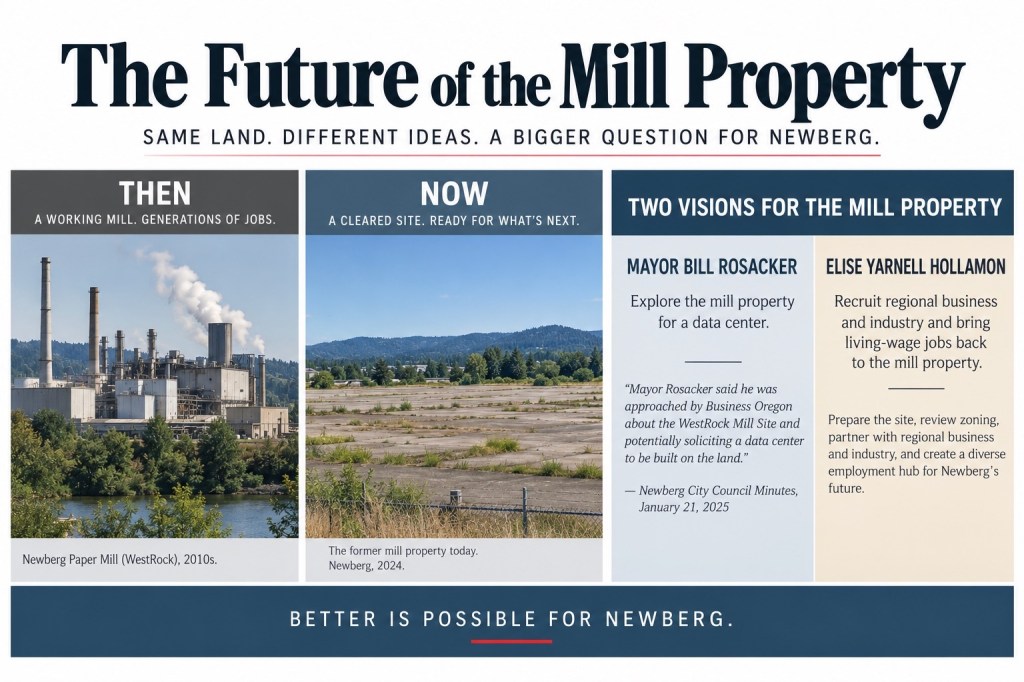
This includes current Newberg mayor Bill Rosacker. In a long Facebook post published in February 2025, Rosacker wrote that he was “somewhat supportive of a small server farm (<20 acres)” on the WestRock mill property in south Newberg. Rosacker argued a server farm could provide several well-paying jobs and a significant tax base while requiring fewer employees to travel to and from the data center site. He also specifically referenced the property’s access to electricity, the Willamette River, water rights and potentially treated wastewater as reasons Newberg could accommodate such a use.
And, just last month, Newsberg reported that Rosacker was appointed to the Environmental Protection Agency’s (EPA) Local Advisory Committee, a group of local and state officials who advise the agency on environmental issues affecting local governments. The committee will begin its new charter by discussing the challenges local governments face in the sustainable siting and development of AI infrastructure and data centers. While this does not mean Rosacker was appointed because of his views on data centers, it does make his February 2025 comments particularly relevant as Newberg discusses the future of its own industrial land.
Surely Rosacker recognizes the unpopularity of data centers in Newberg, and the community’s general resistance to having them planted at the mill site. Because it’s clear that Newberg also does not want a data center built here. Why else would petitioners for a Rural Heritage Park ordinance use data centers as an enticement to gain signatories?
As the political action committee Share Our Parks organization pointed out in an July 31 Facebook post, the petitioners for a Rural Heritage Park ordinance were misleading others. Petitioners, text messages, and signage suggested a bill would assure that data centers were permanently prohibited from Chehalem Park and Recreation District property. This obfuscated the real intent of the petition: to keep bike riders from using trails at Crystal Rilee Park, raising questions about whether a small group of people should make decisions about publicly-funded, publicly-maintained properties.
The messaging from Rosacker about data centers is muddled, perhaps because they are so unpopular, and because he was for data centers, until nearly everyone else was against them. These are policy questions he should more readily answer: Does he still support placing a data center of up to approximately 20 acres on the former mill property? And, given his new federal advisory role, how should communities like Newberg balance data-center development against water use, energy demand, industrial-land scarcity, employment generation and neighboring residential areas?
Rosacker’s opponent, Elise Yarnell Hollamon, is offering a different, far more transparent and compelling position. She acknowledges that data centers are part of the infrastructure supporting modern technology, but does not support placing one within Newberg or rural Newberg. Our community’s limited industrial and employment land should instead be prioritized for uses that generate substantial numbers of living-wage jobs and contribute to a vibrant riverfront and mill district.
“Data centers are an inevitable part of modern life,” Hollamon told us. “Every day, we rely on technology that requires this infrastructure, and pretending otherwise isn’t realistic. What is realistic is being thoughtful about where data centers belong and scrutinizing their impact on the communities where they’re proposed. I do not support a data center within Newberg’s city limits or rural Newberg.”
Hollamon has a mill strategy that begins with bringing the property back online and developing it as competitive employment land. She proposes revisiting and revitalizing the Riverfront Master Plan, directing eligible Urban Renewal resources toward infrastructure and predevelopment barriers at the former mill, and building a direct working relationship with the private property owner so Newberg has an active seat at the table as the site’s future is determined.
For Hollamon, the mill is fundamentally an affordability and economic-development issue. Newberg has lost significant manufacturing employment, and the former mill represents one of the community’s most consequential opportunities to recruit new employers. Her argument is that public economic-development tools should be used intentionally to lower the barriers preventing private investment, rather than waiting for the market to determine the future of the riverfront without meaningful city involvement.
Her plan also considers River Street and its thriving as an established residential neighborhood. While River Street residents are already navigating significant questions surrounding road reconstruction, Hollamon argues that the ultimate use of the mill should account for traffic, neighborhood impacts, the riverfront and the city’s broader economic-development goals—not simply tax-base generation.
Fundamentally, in our efforts to build a better community, we believe that thoughtful planning is necessary, rather than ready capitulation to tech companies looking for cheap land and energy to build their data farms.
This is why Newberg Neighbors is supporting Elise Yarnell Hollamon: someone who is for all of Newberg, not just the privileged few. We believe Better is Possible for Newberg.
 Newberg Neighbors for a Better Community
You must be logged in to post a comment.