
It’s Worse That We Thought, Part Two

Last week, thanks to a FOIA request, we learned that 197 educators have left Newberg schools. Although the school board will claim that this exodus follows national trends, we now know for certain that Newberg is losing educators at an alarming rate, taking talent, institutional knowledge, and stability with them, and thus having an adverse impact on children in the district.

Meanwhile, the school board continues singing its favorite tune: Everything is awesome, and there’s nothing wrong here. You can hear the latest iteration of that song from the board meeting last Tuesday night, where the newest proposed changes–a trimester system for all!–will magically save every residual problem left over from the last board. 

You could also hear that everything is awesome in the offering put out by the school district’s communication department, where incumbent Shelley Kolb interviews Superintendent Steve Phillips in a video that seems to promote Kolb and Phillips more than what’s actually happening in any of the schools. Everything is awesome, especially when the superintendent is making what amounts to a campaign video for a school board that oversees his work and decides his salary. More about that some other time.

For now, we wanted to share the story of someone who works as a parent leader in Newberg, and who serves as a volunteer in two different schools within the district. “I see a lot right now that is not right” in the district, she says. “But also not being shared.”

She articulates two concerns that are directly impacting children:

Paper or Pads?

The Newberg School District is asking individual schools to cover the cost of menstrual supplies, rather than provide funding itself or take funding from the state. The Menstrual Dignity Act, signed into Oregon law in July 2021, requires that all K-12 schools provide free menstrual products in its bathrooms. According to this parent volunteer, the current school board, following right-wing outrage about the act, chose not to accept money from the government allocated for this law, and are telling schools to pay for period products from an account intended for paper, tissue, and other classroom supplies.

“In many cases it is the Resource Room Funds being used,” the volunteer said. “We are learning, as these funds are low at the end of the year, that our offices are having to choose pads over paper. Otherwise, our students will be going without.”

Now, some folks might say that girls can just do what girls have done for decades, bringing their own products from home. Indeed, that seems to be what the board is suggesting. The Menstrual Dignity Act was built on the understanding that one in five girls miss school each month because they lack appropriate period products, and that sometimes, those living in poverty have to choose between expensive period products or food for a family.  Because school resource rooms understand the importance of menstrual equity, they have made sure to cover the funding gap, but the school board policy to not take Menstrual Dignity Act funding means that everyone loses, including children and educators, who won’t have full access to the supplies they need to learn. 

Unfilled Positions

The board and superintendent have claimed that most positions in the district are filled; at the April 11 board meeting, Human Resources Direct Scott Lindenberger said that a job fair had netted a whole host of candidates eager to teach in Newberg schools (though one observer at the same job fair noted that lines by the Newberg table were far shorter than for most other schools). Lindenberger also pointed out that there were a number of special education teachers applying to Newberg jobs . . . 

. . . which is huge, if true, because many positions in Newberg are not filled, especially in special education. A parent tells us that “my daughter is still receiving speech online. Psychologists are still online. We have counseling and sped (Special Education) staff that have never been in these positions and I question their qualifications. 

“WE HAVE NOT FILLED ALL OUR POSITIONS,” the parent added (emphasis hers). “Our buildings are still struggling to date. We are just running on less and under-qualified staff.” 

At a later time, our site plans to address the poor treatment special education students are receiving in the district. Children with a right to educational access are not receiving the accommodations they deserve, because the Newberg schools cannot attract special education teachers, nor have they retained the highly-trained educators who once worked in the district.

This school board insists on parents’ rights. Director Brian Shannon read his entire proposed parents’ rights statement into the record on April 11, and the board has decided to continue convening a parents’ rights committee. And yet, parents with students who need disability accommodations are not able to get the assistance they are assured by law, their rights ignored by a board who wants to demand again and again that everything is awesome. 

The election for a new school board is in five weeks. We have a chance to right this sinking ship, to give students the support they need, and to return hope to parents, educators, and volunteers who badly want their children to thrive.  

Do you work in the Newberg school district or did the Newberg school board compel you to leave this district? We would love to hear your story, and can publish it anonymously on our site. Your voices, and your words, matter to us, and to the transformation of our school board. Feel free to email us at betternsdschoolboard@gmail.com.Newberg deserves better.Your vote on May 16 matters.
Candidates’ Forum Review

The candidates’ forum on Saturday might have been Newberg’s hottest weekend ticket, as a standing-room only crowd listened to all ten candidates for the Newberg School Board share their vision for the district. Kudos go to the Chehalem Valley Chamber of Commerce, the Newberg City Club, and the George Fox University Civility Project for hosting the event. Although some folks are now asserting that the forum was partisan and unfair, it’s important to note that every candidate had the same time to talk, and every candidate had the same questions, prepared by a nonpolitical committee made up of Newberg citizens.

The moderator established clear ground rules that kept the forum from becoming a free-for-all circus. This included the prohibition of clapping and other verbal displays of approbation or disapproval, making the event far more civil than even recent school board meetings. Though one attendee took to Facebook to call the event “left-wing virtue signaling,” the candidates’ forum gave citizens an opportunity to make informed voting decisions, important if we want democracy to survive.

The incumbents, plus two other candidates running on the parent’s choice docket, had clear talking points, and all five offered some version of the following:

The new superintendent is super! 

Superintendent Steve Phillips received high praise for turning around what the incumbents asserted was a district in disarray.  According to one incumbent, Phillips was able to “hand-pick his district office,” which is rarely the case, and because of him and his staff, the schools are finally, finally on the right course.

Never mind that at least 197 educators left the district because of the hostile work environment created by this board, nor that Phillips got to handpick his staff because almost all district office employees left for other schools. Judging by the candidates’ forum, Phillips was literally God’s gift to Newberg.

By almost every metric, this assertion is untrue.

Parents should be involved!

We’ve covered the parents’ rights movement elsewhere, and it’s clear that Chair Dave Brown and his board believe that parents have inalienable rights, above anyone else, including teachers and children. At the candidates’ forum, Brown was most insistent that parents can dictate every part of their kids’ education, and the board should be writing new policies to codify the parents’ power.  

Never mind that the Newberg school district already has at least two dozen pages of policy regarding parental involvement, something Zone 4 Candidate Nancy Woodward pointed out in her comments. Never mind that the Newberg School Board has made two significant decisions in the last month without involving many (or any?) parents, moving secondary school schedules to trimesters, and changing start times to earlier for all ages. 

By almost every metric, the assertion that the board currently supports all parents’ rights is untrue.

Politics Don’t Belong in The Classroom!

Once again, Chair Brown insisted that politics don’t belong in schools, and that the policy in 2021, banning Pride and Black Lives Matter flags in the classroom, was about wanting to get back to educational basics. It had nothing to do with politics, really, and wasn’t even about Pride or BLM symbols at all.

Never mind that Chair Brown can be seen on video from the July 13, 2021, board meeting saying that the ban was specifically about Pride flags, and about Black Lives Matter flags. That particular meeting began a cascading series of failures for the board: Firing a superintendent who told them their ban was illegal, and he would not support it. Digging in, even though the board knew the ban was illegal. Facing lawsuits because of its illegality, costing the district funds that could have supported student learning.

By almost every metric, Chair Brown’s claim of being a-political in his decision making is untrue. 

This Election is About Integrity, Transparency, and Competence

At the forum, the five other candidates (Woodward, Jeremy Hayden, Deb Bridges, James Wolfer, and Sol Allen) offered steady and studied responses that centered children first and then educators, while empathizing with parents’ concerns. 

The forum was also a reminder that three of the five candidates have children who attend Newberg public schools (or will), a distinct contrast to incumbents who have little stake in the district, because their children are homeschooled or attend private schools. In the words of incumbent Raquel Peregrino de Brito, who has a child attending a Christian private school, her stake in public schools is simply because her kid will have to interact with children who attend public schools.

We imagine that most people who attended the forum already had their minds made up about who to vote for on May 16. And still, the event clearly showed what’s at stake in this election. 

Changing the trajectory of this board will require extraordinary effort in getting all our neighbors to vote, because Newberg’s children deserve a better school board, one focused on integrity and transparency, rather than misleading and misdirection. 

Why The Candidates’ Forum Matters

At the Newberg School Board meeting last night (April 11), Director Renee Powell used her public comment time to excoriate the Newberg Educational Association, the local teachers’ union that has endorsed five candidates for the school board, none of whom is currently on the board. Director Powell railed against the NEA, noting that she had talked with many teachers who don’t support the NEA’s endorsements and their leftist agenda. 

The screed included all the buzzwords currently prized by politicians to stir up fear of some progressive boogeyman: about control, and parents’ rights, and teachers with malformed agendas. Neither Powell, nor her fellow directors, have said much of substance about how they will support all educators, especially as the district makes dramatic changes in start times and in moving to a trimester system. 

As has been increasingly common, the boards’ comment did little to show what kind of substantive support they want to offer the teachers or the students they serve. Instead, the board and superintendent have used their platforms for airing grievances, a Festivus tradition carried into every board meeting the last two years.

Which makes it difficult to know what significant policies the incumbents–or new “the parent’s choice” candidates–hope to institute in Newberg schools, beyond the vague platitudes of the voters’ pamphlet. (We’ve already covered the factually-challenged candidates’ statements in the voters’ pamphlet.)

Turns out, the candidates’ websites don’t do much good, either. For the parent’s choice candidates, the same vague information from the voters’ pamphlet has been cut and pasted into their websites, with little more substance than the same vague promises of academic excellence, fiscal responsibility, and parental involvement. We don’t know the candidates’ plans for achieving these goals, nor the policy changes they might institute. On incumbent Raquel Peregrino de Brito’s site, there’s little more than pablum for the right, even though Peregrino de Brito has been a board director for over a year, and should have a record of decision-making that she’d want to run on. 

This weekend’s candidate forum might be the best–and maybe the only–place to hear what the incumbents’ specific plans are for serving the district, as well as the plans of the two other parent’s choice candidates, running for the first time. It will be interesting to see what all of the candidates have to say, what policies they are imagining, and how they might distinguish themselves from the other people in the field.  

This non-partisan event, hosted by the Chehalem Valley Chamber of Commerce on Saturday, April 15, starts at 1 p.m. in Hoover 105 at George Fox University. Being an informed voter is an important part of sustaining a fragile democracy. This event is a good test of whether any of the candidates can move beyond buzzwords and fear-mongering to a substantive and civil discussion on policy. For the good of our community, and for our children, this event should be worth your time.

A Teacher’s Perspective: It’s Worse Than We Thought

Late last week, a Newberg resident reported that, according to a FOIA request, the Newberg Schools district office revealed that “between Jan. 2022 to early March 2023, 197 teachers and staff left Newberg schools.” This exodus represents a significant percent of Newberg Schools employees, a stunning number that reflects enormous loss for our community: All that institutional memory, gone. All that talent, scattered to nearby districts.

The current school board and superintendent have persistently said that Newberg’s losses are part of a nation-wide personnel problem, and that similar depletions of work forces happened in nearby districts, too. In claiming that educators are leaving the profession altogether, the board hopes to deflect responsibility, unwilling to consider that their own failed policies, their ethical lapses, and their politically-motivated actions have created a toxic work environment in Newberg, compelling employees (nearly 200 of them!) to flee.

But don’t take our word for it: listen to the educators’ stories, including the one we’ve reprinted below. The teacher works in the district, but because they fear recrimination and harassment, they’ve asked that their story be published anonymously. “Before the board and its advocates critique me for ‘living in fear,’” they write, “perhaps consider who created, cultivated, and capitalized on that very fear.”

Here’s their perspective. In particular, the teacher is talking about Brown’s statement made at a school board meeting and available here.

In the past year and a half, Chair Dave Brown has repeated sentiments we can trace back to at least August 10, 2021. At a board meeting that night, Brown made several statements that danced around the issue of why our district faced public backlash, taking the Zoom-call stage and to talk about division, politics, the value of hard work, and the content of our hearts. While he has vocalized these ideas, I have yet to see Brown live any of them out as the School Board Chair. He’s claimed to focus on maintaining high standards and pushing for “hard work and no excuses” from our staff and students.

Any educator, regardless of title, would likely agree that our students need to be challenged to work hard, to an extent. Our students deserve to be held to a high standard of academic achievement because we know they are capable of it. In fact, a trauma-sensitive educator will tell you students need healthy cognitive challenges to push them to work hard in order to develop resilience, self-efficacy, and academic success. We know people rise to the challenge when it’s presented to them, and we know our students need scaffolds – or intentionally planned supports – to fulfill the challenge.

Most educators will not, however, tell you that Brown’s approach has been effective.

What he calls excuses, we call barriers. While he writes off the trauma and difficult circumstances of our students as excuses, our educators are working with students to reach a point of physiological safety so they can learn. If you walk into any entry-level education course, you’ll learn right away about Maslow’s Hierarchy of Needs and other similar models. These models show the importance of physical and psychological safety before we’re able to process new information and learn. If a student does not feel safe and cared for, their ability to develop skills and take on cognitive challenges will be severely inhibited. Our educators are working non-stop to create the conditions where students can feel safe in order to learn.

All the while, this Board, under Brown’s leadership, has created an environment where many students can’t work hard. Rather, this Board has been detrimental to students by placing the weight of problems on the shoulders of children and adolescents. As Brown said in August 2021, “As a country, I feel like we’re trying to bring a lot of adult and grown up battles into the classroom.” Last year, as the school board was pushing for their flag ban, facing multiple lawsuits, firing a trusted superintendent, I watched as my students’ shoulders sagged under the weight. I maintained my standards; I knew my students were capable of deep, complex thought. 

But I never had board-directed support about the high expectations in my classroom. Instead, I saw more and more students requesting to take a break. To go to the counseling office. To take a lap. As the chaos spiraled, so did the behaviors of the very students who were struggling to bear the weight of what Brown calls “grown-up battles.”

Students of color shared fear of racism and bigoted remarks as they walked through the halls. LGBTQIA+ students, the ones who shared their identities with others, expressed fear of bullying and harassment. And we can only guess how many closeted students, especially students of color, feared being outed or even uttering their identity. 

These bans and policy moves, in Newberg and across the country, are not about “protecting children.” They’re about protecting power and control out of fear of something people don’t understand. If it was about protecting children, we’d look at what they need to grow and thrive in developmentally appropriate ways. Instead, we’re breaking down the safety of our schools for our students – regardless of background and identity – in order to create a political arena. We strip our buildings of safety, making hard work impossible and risking the developmental progress of our students.

All of the work to create a productive learning environment for my students in my classroom was, and is, limited to the resources I have available between my team and my own means. All of the work to create space for students to have “hard work and no excuses” was my own, and was undermined every time the Board met. As a teacher, I work with students on a daily basis to promote “hard work and no excuses.” My students know they will be compassionately held accountable, given space to make mistakes while also being responsible for those mistakes. Excuses are not allowed, but explanations are. Hard work and high standards only work when we have compassion.

But from Dave Brown? I have yet to see him live out what he said at the start of the chaos he helped stir up and led the charge on. Standards? Hard work? Compassion? Nope. But excuses? Again, and again, and again. It’s always someone else. The old superintendent, the teachers’ union, the “liberal” board members who stepped down, the media. Probably me, if he ever reads this. And yet, I have yet to see him take responsibility for the ways his reckless leadership has harmed this district financially, academically, professionally, and – for our remaining staff and students – mentally and emotionally. Dave Brown and I, on the surface, agree about the importance of high standards and hard work. We clearly disagree, however, on what these look like.

For him, it means removing psychological safety from schools and lowering the standards of our district. (Or maybe we hired B&B so their poor grammar and inability to credit staff members with their own names would make our elementary-school students seem more impressive?) It means ignoring research and best practices designed to support student well-being and success in and out of the classroom.

It means vilifying the professional and revered educators and leaders in his own district in order to push his own agenda. It means instilling fear in educators so they’re afraid of speaking out, trying new strategies, or teaching their board-approved curriculum for fear of retaliation and public harassment.

It means taking away student identity and autonomy in the name of “colorblindness” and “removing politics” from schools. It means criticizing the expertise of staff members, pushing many out of his district because he refused to follow his own suggestion of listening to people and preventing division.

It means blaming our educators for the mass exodus of students and extraordinary financial losses this district has faced at his hands. It means smearing the blood he has coated his hands in on the educators and leaders who have worked to triage an entire school district.

With his own criteria at the forefront, Dave Brown has failed on all accounts. Our educators are all hard working. Brown is all excuses.

Do you work in the Newberg school district or did the Newberg school board compel you to leave this district? We would love to hear your story, and can publish it anonymously on our site. Your voices, and your words, matter to us, and to the transformation of our school board. Feel free to email us at
betternsdschoolboard@gmail.com.

Newberg deserves better. Your vote on May 16 matters.

Fact-Checking The Voters’ Pamphlet

If you’re registered to vote in Yamhill County, your ballot should arrive on April 26; if you’re not registered to vote, you have until April 25 to do so (here’s the link to online registration!). This election year, every vote is crucial to electing a non-partisan, competent, and accountable school board that will right the floundering ship that is currently the Newberg School District. 

While the voters’ pamphlet that accompanies your ballots should reliably provide guidance in helping you vote, make sure you read the very fine print tucked away on page two of the document:

“The candidate statements and measure arguments contained in this pamphlet are printed as submitted and have not been verified for accuracy by the county.”

This tidbit of information is crucial, because goodness: the candidate statements from Newberg school board incumbents are in dire need of some fact-checking. While we acknowledge that candidate position statements will always be aspirational, this spring’s claims by school board incumbents suggest they are living in an alternate reality, one in which Newberg schools are finally thriving, educators are finally supported, and students are finally experiencing academic success. 

Judging by the candidate statements, Chair Dave Brown deserves a major award for unifying the community, saving Newberg from the dark ages and rescuing children everywhere from the educational “indoctrination centers” that were once Newberg schools. Brown’s statement asserts that “we can once again be proud of our schools,” even though our school board’s actions have helped put Newberg in the national news several times in the last two years–and not for good reasons.  

Brown claims that “our district has experienced a remarkable turnaround.” The turn in our schools has been remarkable, but not in the way Brown wants us to believe. Here’s some of the ways Newberg schools have “turned around” since Brown became board chair in 2021:

The district has lost 139 educators, who left the toxic work environment in Newberg. 

The current board will say this reflects “national trends,” but no other nearby district lost educators at this rate, and many former employees did not quit education altogether (which is a national trend). Instead, educators moved to positions elsewhere, taking their institutional memory and skills with them.

The district has moved from a stable financial position to one of financial uncertainty.

Between legal fees (which increased 1000 percent from over the course of one year, according to Oregon CARES PAC), the no cause firing of Dr. Joe Morelock, and lost revenue in the district, Newberg schools will face big cuts in programming next year. You can read more about this here.

The district is hemorrhaging students.

Chair Brown’s statement suggests Newberg has “increased student enrollment,” but the numbers don’t lie. In one academic year, the Newberg School District lost 130 students, more than any other nearby district. McMinnville gained 78 students, and Sheridan gained 58; other schools who lost students include Sherwood (who lost 2) and Yamhill-Carlton (who lost 9). The NSD loss reflects about $1.2 million in funding. 

The school board has violated ethical standards set by the state of Oregon.

You can read more about the ethics violations in this post. In addition to violating public meeting laws, the board is also embroiled in several lawsuits that might cost the district–and thus the students–millions of taxpayer dollars. This betrayal of ethical principles does not reflect the idea of “accountability” upon which the incumbents seem to be running.

For a school board who claims to have created “overall staff, parent and student satisfaction,” according to another incumbent’s voter pamphlet statement, there certainly is evidence that plenty of people in Newberg are not satisfied, including the Newberg Educational Association, which has not endorsed any of the incumbents running for reelection, nor a significant number of parents, organizing to make sure their children get competent, safe, accountable representation on next year’s board.

The ballot box is our best opportunity to truly turn around a failing district. If you’re not registered to vote yet, please take the time to do so. And then, on May 16, let’s deliver the “turnaround” this community really deserves, rather than the one dreamed up out of whole cloth.

What Fiscal Responsibility Looks Like

A voters’ pamphlet for the May 2023 election has been posted online, and will be headed to Oregon mailboxes soon. As you read through the stated goals for current Newberg School Board directors up for re-election, you will note they claim to support “fiscal responsibility.”  

But what does fiscal responsibility actually look like?

These board members will tell you that they righted a sinking ship–that it was only when they took over the board and fired Dr. Joe Morelock that Newberg found stable financial footing. We suspect they will use this year’s audit to support claims that the previous board and Dr. Morelock impoverished the district. 

Be wary of this smoke-and-mirrors attempt to position the current board as fiscally responsible, because the truth is a lot more complicated. Indeed, far from being responsible, the current board has cost the district plenty, and its decisions will continue to crater Newberg’s schools, leading to fewer programs, fewer talented teachers in the classroom, and fewer opportunities for Newberg’s children.

Gregg Koskela, who recently won a state-wide award as communications director for the Cascade School District, knows well the costs of the school board’s decisions, and understands clearly how a disastrous audit can be recast to hide the district’s financial precarity. Koskela was a longtime communications director for Newberg, as well as serving as point person for the bond, until he resigned last summer. 

In a well-researched and thoughtful blog post this weekend, Koskela clearly outlines the audit process, and explains why the board directors’ claims of “fiscal responsibility” is not reflected in the district’s real financial state. Koskela’s post offers just one more reason that the May 16 election matters to the flourishing of our school district and our school children, and to the future of Newberg itself.

You can read Koskela’s excellent blog post here

When An Apostrophe Means So Much More

In the 2021 Newberg school board elections, a consistent refrain was that new candidates needed to “Save Our Schools,” returning students to the basics of reading, writing, and mathematics. Newberg citizens were told that educators weren’t teaching kids, too focused on politics and indoctrination to care about educating. 

A new school board would “raise the academic bar for all students,” according to a candidate’s platform, articulated in the Yamhill County Voters’ Pamphlet. “Let’s expect more and lets deliver,” the candidate wrote, perhaps forgetting that a high academic bar would require that Newberg students write grammatically correct sentences. 

Sometimes, it seems, an apostrophe matters.

No doubt you’ve seen the signs currently around Newberg, promoting a block of candidates for this May’s school board election, but using an apostrophe incorrectly (unless, of course, there really is only one parent in Newberg intending to vote for Chairperson Dave Brown and the other four candidates). 

It might seem pedantic and petty to point out this error, a simple typographic mistake we are all in danger of making now and then. But when a block of school board candidates are arguing that our students need to achieve more academically, and when these candidates insist that they are first and foremost about reading, writing, and arithmetic, then a misplaced apostrophe on numerous signs spread throughout the region really does matter. 

According to the Oregon Standard for English Language Arts, students learn the appropriate use for apostrophes in the second grade (page 17 outlines this standard). Of course, any high school language arts teacher will tell you that writers continue to struggle with the conventional English standards until they graduate, usually because they have failed to internalize the rules, because they are careless, or because they don’t edit well, if at all.

It’s also not entirely clear whether the school’s current communications team has not yet internalized the rules of Standard English, if they are careless, or if they don’t edit well. Bridge and Bolster LLC, which essentially received a no-bid contract in August 2022 to run the district’s communications department, consistently makes errors in its documents, from misplaced apostrophes to misspelled words to wrongly-identified employees in social media posts. As one district parent recently asked, “at what point will parents be frustrated enough to expect 7k worth of work?”

The parent went on to say that she has spoken privately with Bridge and Bolster, suggesting they do a closer edit, and several others on the Facebook post also mentioned discussions with the marketing firm, asking them to be more accountable for the taxpayer money they receive each month by communicating more clearly with their constituents. An educational enterprise having so many errors in their communications is embarrassing, a number of people have noted, especially when some of the students served by the district could provide stronger writing and editing skills.

Bridge and Bolster became a company only seven days before starting with the Newberg School District; you can read about its controversial hiring here. Its owners had zero experience providing direction and expertise for a complex communications department, one that needs to produce clear information to numerous constituents and through multiple channels. A district already in disarray needed professionals who can write clearly and correctly, and who can do far more than post on social media and shoot promotional videos for the district office.  

As one former educator said, “I’m more upset that most posts are about the adults in the district, instead of focusing on students, volunteers, academic scores or plans to move our schools and students in a strong direction. We are paying $84,000 that does nothing to inform parents of how our schools are educating our students and preparing them for life after high school.” 

A strong school district has an experienced communications team, connecting with parents in the district and celebrating the academic accomplishments of its students. A strong school board doesn’t need its district communication team cheerleading its efforts, because its hard work will be manifest in the success of its students. A strong school board will be transparent about who it hires–and about why an inexperienced marketing firm received a lucrative contract. 

A strong school board will be accountable, transparent, and competent, aware that even an apostrophe can be the difference between a parent’s choice, and parents’ decisions to vote for candidates that can serve the district well. 

The Problem with Timing (and with Start Times)

The first day of Newberg’s spring break brought with it several surprises: a skiff of snow on roads and yards, definitely unusual in late March. There was also an announcement from Newberg Public Schools: start times for the elementary, middle, and high schools would be earlier next year. 

For this current school board, the confusing nature of the announcement and the lack of transparency about how the decision was made is definitely not unusual. 

Actually, the district made its announcement just before 5 p.m. on Friday, letting parents know on their Facebook and Instagram pages about the change. The backlash was almost immediate: two days later, almost 240 comments have been made on the Facebook page alone, many of them by angry parents who feel left out of the decision-making process–parents for whom even a 20 minute shift in start times will mean disruptions for their children. 

The Newberg School District policy is clear: the superintendent is well within his right to make a decision about start times unilaterally, without the feedback of educators, parents, or even the school board. Yet for a superintendent and board who seem focused on parents’ rights, and who fashion themselves as “the parent’s (sic) choice” (at least according to campaign material), the lack of transparency about the change is troubling, especially when compared to past boards and past superintendents.

Ahead of proposed start time changes in 2021-22, the school board convened an ad-hoc committee: to study the data; comb through research on what early start times mean for younger children as well as teens; get feedback from the community; and make a recommendation to the school board for approval (even though, again, then-Superintendent Joe Morelock could have made a unilateral decision). 

If you look at meeting minutes from January 12, 2021, you can see their robust report, including links to research about sleep and mental health, as well as an explanation of scientific research on start times (the report starts on page 31 of an extensive board packet). The ad-hoc committee also met with community members on January 5, 2021, as well as compiling data from a survey sent to all parents in the district. In March of that year, Superintendent Morelock provided a final report to all families in the district, preparing them for the announcement about new start times.

This weekend, on the school district’s Facebook page, parents feared that a decision was made without their input, especially given the extraordinary hardship an earlier start and release time might have for working families and for children’s time with parents at home. In some comments, parents reflected on the struggle their children are already experiencing with early start times, and their concerns about kids waiting for buses in winter morning darkness. A number of parents asked Had anyone asked parents about how the changes would impact them? 

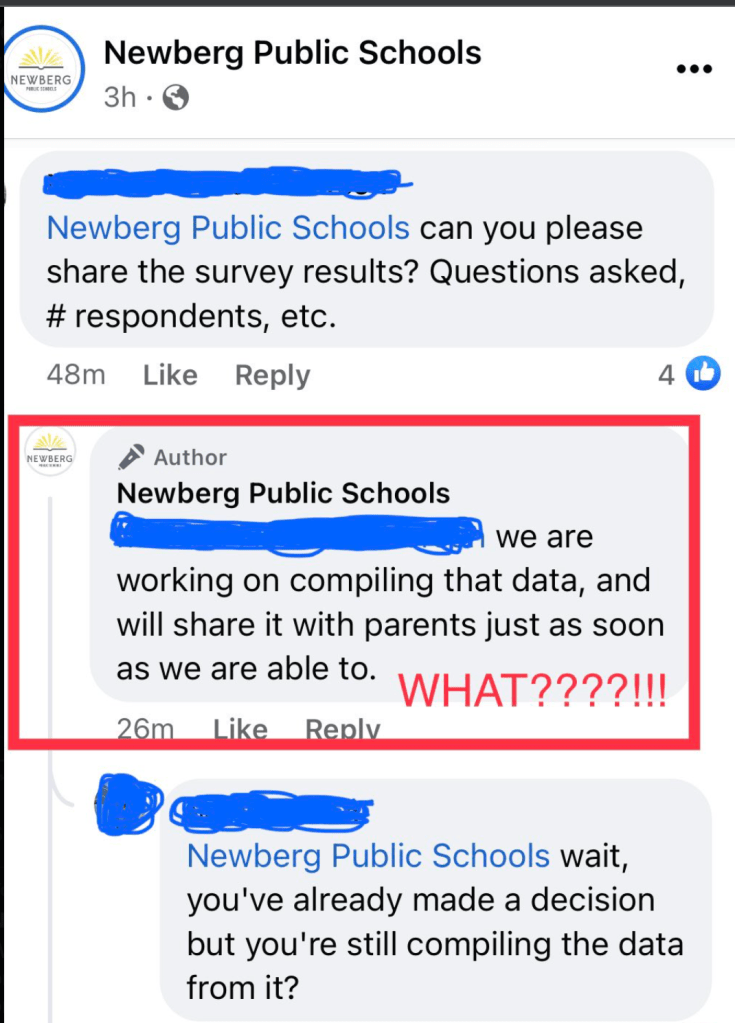
Apparently high school parents were surveyed near the last day of school in June 2022, but younger parents were not asked for feedback. Since then, there has been no follow up about how that survey data was used. Questions on the post about the lack of feedback regarding the school district announcement were met with confusing responses. 

One response from the school communication team noted the district was still compiling data, and thus couldn’t share it yet; but then, in subsequent responses, the same person said that the data had been compiled, but couldn’t yet be shared. Both answers were confusing, especially when the communications team seemed to be editing answers on the fly, making the decision seem even less informed.

A person who will no doubt be happy about the controversial decision is Chair Dave Brown, the self-appointed parent’s choice for reelection in Zone 6. In 2021, Brown tried to compel the board to choose earlier start times for high school students (and subsequently middle and elementary schools as well), despite overwhelming evidence that this change was unwanted by many parents and students in the district. His fundamental consideration seems to be high school athletes who might miss afternoon classes to travel to competitions, and whose practices would be affected by a later dismissal time.

The meeting minutes leading up to the decision in 2021 show in stark relief the one-time transparency of Newberg’s school boards, their integrity in communicating with the public, and their desire to make sure that all Newberg students were well served by the policies they created, including start and dismissal times for all schools.

Announcing an unpopular decision right before spring break is problematic. Being unwilling–and unable–to explain the data that informed the decision is also troubling. Refusing to consider the science of children and sleep, including studies released in the Newberg schools’ own report just two years ago, makes it difficult to understand why the change needed to be made at all. Except, maybe, for the benefit of Coach Brown. 

As we’ve said, the election on May 16 is about transparency and integrity and doing what’s best for students. But like snow falling on the first day of spring break, the decision about start times was not welcomed, not needed, and left huge parts of Newberg feeling left out in the cold.

Here, Right Matters

With Newberg’s school board elections less than two months away, the division and rancor in our community continues to build. James Wolfer’s decision to stop his campaign for Zone 6 board director this week, citing harassment at his job, highlights the attempts to silence people in Newberg who speak truth to power. 

We want to support Wolfer in his efforts to protect his family and his livelihood. We also want to grieve that this is what our community has become, where someone volunteering for a nonpartisan position in the Newberg school district can find his integrity as a police officer questioned, forcing him to make an untenable decision. 

In our sadness, it’s easy to give way to despair, deciding that the turmoil in Newberg will always be this way, or that we should use the same tactics of harassment and provocation that have been used to silence people in Newberg. It’s important to remember, in these moments, that in the words of Alexander Vindman, “here, right matters.” 

Here, right matters in an election that is not about progressive or conservative ideals, but about accountability, transparency, and competence, qualities to which we should all aspire, no matter our political leanings.

Here, right matters when fear-mongering about educators and about schools sows distrust in our teachers and the hard work they do. 

Here, right matters when board members claim to be “the parent’s choice,” even though a substantial number of parents do not choose a board director who seeks to silence them.

Here, right matters, and so we will continue to focus on what matters most in this election season: Accountability, transparency, and competence. Responding to harassment and smear campaigns by speaking truth to power. 

And also, voting for #JamesAnyway, who is the choice of this–and many, many other–parents.*

*Because James Wolfer’s name will continue to be on the ballot, voting for him rather than his opponent will send a strong message and, should Wolfer win, a replacement can be seated by the newly-elected board.

Who Sits at the Table?

On Friday afternoon, the Newberg Public Schools Facebook page posted a picture of a dozen Newberg-area business and government leaders enjoying lunch together at arguably the best restaurant in town, Rosmarino’s. The photo included Superintendent Stephen Phillips, Newberg Mayor Bill Rosacker, Newberg Councilperson Elise Yarnell, and Yamhill County Commissioner Lindsey Berschauer, as well as other folks representing Newberg’s business district, brought together with the premise of finding common ground and creating partnerships within Newberg.

Of course, Newberg is desperately in need of finding common ground and collaboration. This Rosmarino’s meeting was ostensibly intended to bridge a chasm between groups, and certainly that should be lauded. One potential outcome, as Councilperson Yarnell noted in the post comments, is a partnership with Commissioner Berschauer, bringing fentanyl addiction curriculum to local schools. This is an important initiative, and could make a difference in our community. 

And yet, the picture itself is tone-deaf at best. At worst, it serves as a reminder of who remains marginalized in our community and by our school board, providing a stark representation of who gets to sit at the table where decisions are made (and good Italian food consumed); and who is on the outside, impacted by decisions about which they have no say (like deciding how to spend the taxpayer money that presumably paid for a Rosmarino’s feast).

It’s not clear who initiated this dinner, or who received invites. As one Facebook commenter noted, tongue firmly planted in cheek, “I see so much minority representation and inclusivity in this photo. I forgot to mention that there are also many parents of Newberg students.”  In response, someone who attended the meal, Kristin Stoller, said she might have been the only person there with children in the Newberg school district. Every person in the picture was white.

If a picture is worth 1000 words, this one might have narrated an entire epic about the last few years in Newberg, when a powerful few make decisions in the name of “what our community needs,” marginalizing large swaths of the community in the process.

Fundamentally, though, if the leaders seated at that table wanted to provide healing for a divided community, there are easily-achievable steps they could take right now to begin building bridges:

  • They could talk directly to constituents who have asked to meet with them. School Board Chair Dave Brown, smiling at the table, has refused meetings with parents his board serves. According to one response to the picture, a constituent–and a community leader in his own right–has asked three times in the last month to meet with Brown, who says there’s no reason to meet because this person “is not a supporter.”
  • They could take accountability for some of the mistakes they’ve made. That includes the school board’s back-room planning to fire former Superintendent Joe Morelock, recently ruled unethical by the Oregon Ethical Commission. They could apologize for ways their own actions have hurt students, rather than consistently blaming previous boards for the mistakes this current board has made. They could admit that their decisions compelled over 100 educators to leave the district, rather than blaming the astounding exodus on national trends.
  • Chairman Brown could apologize for his grievance-heavy public comments. This includes the six-minute discourse he gave at a school board meeting less than three days before the Rosmarino’s luncheon, during which he railed against people in his district, while also obfuscating about when he filed his re-election paperwork.
  • Chairman Brown and other community leaders could publicly disavow the work of the Yamhill Advocate. That publication’s smear campaigns resulted in death threats against Councilperson Yarnell; it has continually asserted that progressives in Newberg are part of a mafia, intent on grooming children. As one Facebook commenter noted, “If Dave REALLY means that wants Newberg to heal, then he will distance himself & mention PUBLICLY that Carey Martell’s ‘shenanigans’ aren’t welcomed & are a detriment to moving forward in the upcoming May school board elections.” 

Without taking these steps, claims about building bridges seem like empty promises, a dinner at Rosmarino’s more of a campaign photo opportunity than a good-faith attempt to build bridges Newberg leaders themselves have burned. 

The school district’s Facebook page promises that there will be more dinners, and more conversations. Perhaps this is indeed the step forward the district needs to take. Will the next conversation have far more representation than the all-white, CIS-gendered diners at the last luncheon?

Because while who is at the table matters, it’s who is absent from the table that might matter more. 

Blog at WordPress.com.

Up ↑