Who Sits at the Table?

On Friday afternoon, the Newberg Public Schools Facebook page posted a picture of a dozen Newberg-area business and government leaders enjoying lunch together at arguably the best restaurant in town, Rosmarino’s. The photo included Superintendent Stephen Phillips, Newberg Mayor Bill Rosacker, Newberg Councilperson Elise Yarnell, and Yamhill County Commissioner Lindsey Berschauer, as well as other folks representing Newberg’s business district, brought together with the premise of finding common ground and creating partnerships within Newberg.

Of course, Newberg is desperately in need of finding common ground and collaboration. This Rosmarino’s meeting was ostensibly intended to bridge a chasm between groups, and certainly that should be lauded. One potential outcome, as Councilperson Yarnell noted in the post comments, is a partnership with Commissioner Berschauer, bringing fentanyl addiction curriculum to local schools. This is an important initiative, and could make a difference in our community. 

And yet, the picture itself is tone-deaf at best. At worst, it serves as a reminder of who remains marginalized in our community and by our school board, providing a stark representation of who gets to sit at the table where decisions are made (and good Italian food consumed); and who is on the outside, impacted by decisions about which they have no say (like deciding how to spend the taxpayer money that presumably paid for a Rosmarino’s feast).

It’s not clear who initiated this dinner, or who received invites. As one Facebook commenter noted, tongue firmly planted in cheek, “I see so much minority representation and inclusivity in this photo. I forgot to mention that there are also many parents of Newberg students.”  In response, someone who attended the meal, Kristin Stoller, said she might have been the only person there with children in the Newberg school district. Every person in the picture was white.

If a picture is worth 1000 words, this one might have narrated an entire epic about the last few years in Newberg, when a powerful few make decisions in the name of “what our community needs,” marginalizing large swaths of the community in the process.

Fundamentally, though, if the leaders seated at that table wanted to provide healing for a divided community, there are easily-achievable steps they could take right now to begin building bridges:

  • They could talk directly to constituents who have asked to meet with them. School Board Chair Dave Brown, smiling at the table, has refused meetings with parents his board serves. According to one response to the picture, a constituent–and a community leader in his own right–has asked three times in the last month to meet with Brown, who says there’s no reason to meet because this person “is not a supporter.”
  • They could take accountability for some of the mistakes they’ve made. That includes the school board’s back-room planning to fire former Superintendent Joe Morelock, recently ruled unethical by the Oregon Ethical Commission. They could apologize for ways their own actions have hurt students, rather than consistently blaming previous boards for the mistakes this current board has made. They could admit that their decisions compelled over 100 educators to leave the district, rather than blaming the astounding exodus on national trends.
  • Chairman Brown could apologize for his grievance-heavy public comments. This includes the six-minute discourse he gave at a school board meeting less than three days before the Rosmarino’s luncheon, during which he railed against people in his district, while also obfuscating about when he filed his re-election paperwork.
  • Chairman Brown and other community leaders could publicly disavow the work of the Yamhill Advocate. That publication’s smear campaigns resulted in death threats against Councilperson Yarnell; it has continually asserted that progressives in Newberg are part of a mafia, intent on grooming children. As one Facebook commenter noted, “If Dave REALLY means that wants Newberg to heal, then he will distance himself & mention PUBLICLY that Carey Martell’s ‘shenanigans’ aren’t welcomed & are a detriment to moving forward in the upcoming May school board elections.” 

Without taking these steps, claims about building bridges seem like empty promises, a dinner at Rosmarino’s more of a campaign photo opportunity than a good-faith attempt to build bridges Newberg leaders themselves have burned. 

The school district’s Facebook page promises that there will be more dinners, and more conversations. Perhaps this is indeed the step forward the district needs to take. Will the next conversation have far more representation than the all-white, CIS-gendered diners at the last luncheon?

Because while who is at the table matters, it’s who is absent from the table that might matter more. 

What Do The People of Newberg Deserve?

​​Tuesday night’s Newberg School Board meeting was bookended by comments: in the meeting’s opening minutes, members of the public were given a chance to speak; in the meeting’s final minutes, the board itself was provided an opportunity to talk about the work they’ve done to make education better in the Newberg schools. 

Instead of talking about students, or highlighting the good work teachers have done, or even presenting information on the “improved academic outcomes” the board continues to vaunt, the school board’s comments were characterized by division and anger. The board also made clear that they themselves have been wronged, and not the students who have suffered through several years of a decimated school system.

The comments—those at the beginning, and those at the end—provide a good micro-narrative of the conflict continuing to unfold in our community, and of a board’s chair intent on gaslighting a community into believing he is a victim of a Newberg bullying campaign.

A public comment from Elaine Koskela, identified as a Newberg resident for most of forty years, addressed the divisions roiling our community, noting that school board meetings now strike a tone of fear and resentment, circling wagons around board supporters who are part of the in crowd, and alienating those who don’t proclaim appropriate fealty to the board. Koskela noted that students on the margins are often on the outside, their needs unmet by board decisions.

Later comments by Board Chair Dave Brown essentially proved Koskela’s point, as he argued that some ambiguous they has been on a campaign to destroy him and his fellow board members: that they are criticizing any decision he makes; that they want the school district to fail; and that they accuse him of hating some students, even though the board supports “every single student they come across, every single time.”

Brown’s language in and of itself creates a distinction between the board and their supporters, who are presumably doing everything possible for the students, and everyone else, who apparently cares little for students, and who want the school district to fail so that Brown and his fellow board members will also fail.

Other board members gave a compelling lead-up to Brown’s grievances, talking more about their work than the teachers and students they serve. One director reported that the board is finally “rowing in the same direction,” despite countless metrics that suggest that not everyone in the district is even on the same boat, let alone rowing in concord with the board.

Another director called out the Newberg Education Association, saying that the NEA’s endorsement of five school board candidates for May’s election—none currently on the board—is wrong, a reflection not of teachers’ dissatisfaction with board decisions, but of a union trying to manipulate teachers into voting a certain way.

Startlingly lacking in all the board’s comments is any kind of commendation of teachers, and the hard work they are doing. Or of students, and their achievements. Or of the school’s programs that have succeeded because of hard-working teachers, of dedicated parent volunteers, and of enthusiastic students. (Indeed, a director asserted that the planned creation of a Parent Bills of Rights is not a “negative,” as if those who are questioning the need of a new bill are somehow hoping to circumvent parent involvement completely.)

If the school board really is about student success and academic outcomes, they spend very little time during their comments talking about that, and a whole lot of energy addressing the ways a cabal in Newberg is doing them wrong.

In other words, they seem to be circling the wagons.

Director Brown, during his remarks, said “The people of Newberg deserve better. They deserve an open communication, and the parents deserve a school that’s transparent.” On this, at least, we can agree.

Millions in Funding at Stake: Will You Weigh In?

The Newberg School Board will hold its next meeting tomorrow, and according to the board agenda, there will be a discussion about “SIA.” The good news? The agenda suggests the discussion is “open for comments,” presumably from the public.

The bad news? The school board has yet to inform the public about what SIA is, how it impacts the school district, whether the board has even created a SIA plan, and what that plan looks like. 

Which raises the question: How will people be able to make comments, if they have been given no information about the initiative and the district’s plans for up to $5 million (or more) of funding SIA might provide?  

A bit of history: The Student Investment Account (SIA) funds are non-competitive grants available to all Oregon school districts. K-12 education funding in Oregon comes from state income taxes, lottery funds, property taxes, and federal funds. SIA funds fall under the Student Success Act (2019), which added $1 billion in funding per year for Oregon schools and students. According to the Oregon Education Association website, “This money could be used for  additional instructional time, providing mental and behavioral health supports, reducing class size, implementing a more well-rounded education, fully funding High School Success (Measure 98), improving school safety and more.”

In past applications, Newberg has allotted its SIA funds for reading specialists, behavioral counselors, drug/alcohol counselors, and other learning support efforts. (You can read past applications here.) Given this board’s lack of transparency and its inability to follow well-established OSBA policies, it’s not clear whether Newberg schools will receive this money. Given how strapped the district is financially, and the rumored cuts to important programs, it seems like leaving millions on the table would not be the best idea. 

The application itself requires significant community engagement, but the Newberg School District has offered no forums for engagement, beyond empathy interviews and youth surveys which were not rigorous nor equitable, and assuredly did not include representative populations that will be most served by SIA money: Spanish-speaking, special education, economically disadvantaged, and migrant families. For a board intent on providing “parents’ rights,” parents representing these groups have not been contacted, their needs not inventoried, in any systematic ways.  The law which created the SIA funds requires school districts to use public input to create their plans, and school boards to provide a place and time for public comment on the district’s SIA plan. But there is no plan available on which the public can comment. By now, the board should have at least posted their application online and have a paper copy available at the district office for people to review. There should have been at least one, if not two, presentations to the board about the SIA application, and an opportunity for parents to provide input before a final draft is due to the state by March 31. 

Now, the school board is asking for comments on an application no one has seen. There will be no opportunities to consider revisions to an application, if the community makes comments. With the application due at the end of March, and no more meetings scheduled this month, the community will have no idea what the final application looks like.

By way of comparison, Sherwood schools presented the first read of their SIA application in January, with the report and budget posted, and opened for public comments. Their budget is $5 million, and their planned apportion of the money is available on their website. 

It’s not clear why the Newberg school board has not followed a similar process, why they have not been transparent about the process they have followed, and why they are risking millions of dollars that might help those needing educational support in our district. Is this another example of incompetence? Are they refusing the money because of a politically-motivated attempt to cut ties with federal funding? 

As with many of the school board’s actions, this unwillingness to follow policy is baffling, especially with so much instructional  money on the line. 

So we want to know: will you weigh in? 

At the meeting tomorrow night, of course, but also at the May election. Because with millions of dollars potentially lost, our kids lose, too. 

Ethics Are Another Matter . . .

ACCOUNTABILITY

TRANSPARENCY

COMPETENCE

For the last two years, those who have opposed the Newberg School Board have argued for accountability, transparency, and competence in its operation. The firing of Dr. Joe Morelock at a November 9, 2021, meeting is emblematic of the board’s lack of accountability. Its lack of transparency. And its lack of competence, which led to multiple ethics violations. 

Finally, the Oregon Government Ethics Commission is taking notice.

The Newberg Graphic reported this week that the ethics commission has issued reports about the November 2021 meeting, affirming that the Newberg School Board violated state rules governing administrative boards when it chose to fire Dr. Morelock.

At the time, the board’s majority–Chair Dave Brown, Vice-Chair Brian Shannon, Trevor DeHart, and Renee Powell–failed to follow policies governing executive sessions, including notifying Morelock and other board members about the nature of the executive session. The three other board members, Rebecca Piros, Brandy Penner, and Ines Pina, were supposed to be notified alongside Morelock at least 24 hours in advance of the executive session, and were supposed to receive supporting material (including complaints made against Morelock) before the meeting.

Instead, the board majority violated Oregon administrative ethics by

  • Adding the executive meeting agenda at the last minute, notifying the board only 1.5 hours before the meeting and without supporting documents. (The rules dictate that notice needs to be given 24 hours in advance.)
  • Not telling three board members or Morelock what the nature of the executive meeting might be.
  • Failing to accommodate Piros’ visual impairment with material about the meeting that would help her participate (an ADA non-compliance violation).
  • Providing the board members with a packet containing the complaints regarding Morelock’s tenure as superintendent, and which presumably justified his firing.
  • Transgressing OAR 199-040-0030, which states that Morelock should have been given information about his termination and the complaints at least 24 hours, or one business day, prior to the executive session. 

The complaints themselves suggest the baselessness of Morelock’s firing, and were focused primarily on  vaccine mandates and why Morelock might refuse to apply the board’s flag ban. It was unclear how the complaints were gathered, or how Morelock himself was responsible to rectify them. You can read all the complaints in the complaint, including “Why have you let go of good substitute teachers that aren’t vaccinated but other school districts aren’t requiring vaccines?” and “Why don’t you have more control over your staff? They are out of control, and are not following policies/procedures.”

You can access the case information on the Oregon Government Ethics Commission here. The Newberg Graphic also covered the story here, although the heroic efforts of three board members–Piros, Penner, and Pina–is buried by the story’s lead. Each woman self-reported her attendance at the executive session at which Morelock was fired, making them complicit in the ethics violations. 

And still, they were left with an untenable choice that night. They could leave the meeting right away, well aware of the ethics violations. Or, they could stay at the executive session, knowing that they represented their constituents and that the wrongful termination of Morelock might jeopardize some students and educators they had been elected to represent. 

They chose to stay, even though that meant they would also face investigation by the ethics commission. 

In the end, Morelock was fired without cause, costing the district $175,000 in his salary for the year, plus another salary for the newly-hired superintendent. 

The four board members were not transparent about their actions on that night in November 2021 and now, over a year later, we finally know just how troubling Morelock’s firing was. Led by their chair and vice chair, the board acted in a way that was not transparent nor ethical. It could be that Brown and Shannon were merely incompetent when they failed to follow well-established policies, but either through incompetence or unethical behavior, they violated rules set in place for a reason. 

Does Newberg really want school board members who can’t model the kind of moral, competent, transparent leadership our children deserve? The election on May 16 should answer this question. 

Is Emotional Abuse Just Part of Teen Dating?

When people show you who they are, believe them.

February is Teen Dating Violence Awareness Month, and so it seems appropriate that the Newberg School Board Policy Committee met to consider, among other things, the district’s policy about teen dating violence. If you weren’t paying attention, you might not know about the directors’ discussion regarding this policy, and about one director’s admission that some emotional abuse might just “go with the territory of dating, I’m afraid.”

During the policy meeting, which you can watch here, Director Brian Shannon uses his own teen dating experience to argue that the already-established policy is creating “landmines” for students to walk through, and that students are simply going to decide not to date, rather than worry that they might be accused of committing emotional abuse. The data shows that teenagers aren’t dating as much, Shannon says, and “our species is going to suffer as a result of this.” 

It is true, young people are not dating at rates similar to previous generations. There is no data about Newberg teens and their dating habits, though, and statistics about Gen Z and dating show a more complicated picture than Director Shannon would suggest in his comments about emotional abuse. 

Choosing not to date at all rather than risk emotional abuse seems like a good boundary to take, actually, and it’s doubtful that our species will meet its end because high schoolers decide not to date. At any rate, here is what the Newberg School District policy currently says about teen violence: 

“Teen dating violence” means: 

1. A pattern of behavior in which a person uses or threatens to use physical, mental, or emotional abuse to control another person who is in a dating relationship with the person, where one or both persons are 13 to 19 years of age; or 

2. Behavior by which a person uses or threatens to use sexual violence against another person who is in a dating relationship with the person, where one or both persons are 13 to 19 years of age.

At the meeting on February 22, 2023, Director Shannon objected to the policy’s first definition of teen dating violence, saying that emotional abuse comes with the territory of dating, and that he himself had “some pretty manipulative girlfriends in high school.” He goes on to say “I didn’t realize I was being subject to teen dating violence that whole time because they certainly emotionally abused me.”

Because the definition is so broad, Director Shannon says, it could just come down to a girl deciding that a guy has been mean to her, and she can report the guy for violence, causing issues for the guy. His suppositions about whether emotional abuse should be part of the description or not get no pushback from the other directors there, and only mild pushback from Human Resource Director Scott Linenberger, who says that the policy is about more than teens being mean to each other; he says that teen dating violence, even emotional abuse, should show a “sustained pattern of behavior.” (Though a moment later, Linenberger admits that Director Shannon’s point is taken, and that not including emotional abuse as part of the policy might be feasible.)

Never mind that Director Shannon chose to use an example of a girl emotionally abusing a boy, rather than recognizing (as data shows) that emotional abuse is used equally by boys and girls in relationships. Never mind as well that the same data shows that emotional abuse is the most prevalent form of dating violence for teens. 

The entire meeting is worth a watch. At a time when the Newberg School Board is arguing that parents deserve rights to protect their children from sex- and gender identity-related indoctrination, they are hoping to rewrite a policy on teen dating violence. Doing so would remove significant protections for those who face psychological abuse in their relationships, simply because such violence “comes with the territory” of dating. 

When people show you who they are, believe them.

Safety Sunday

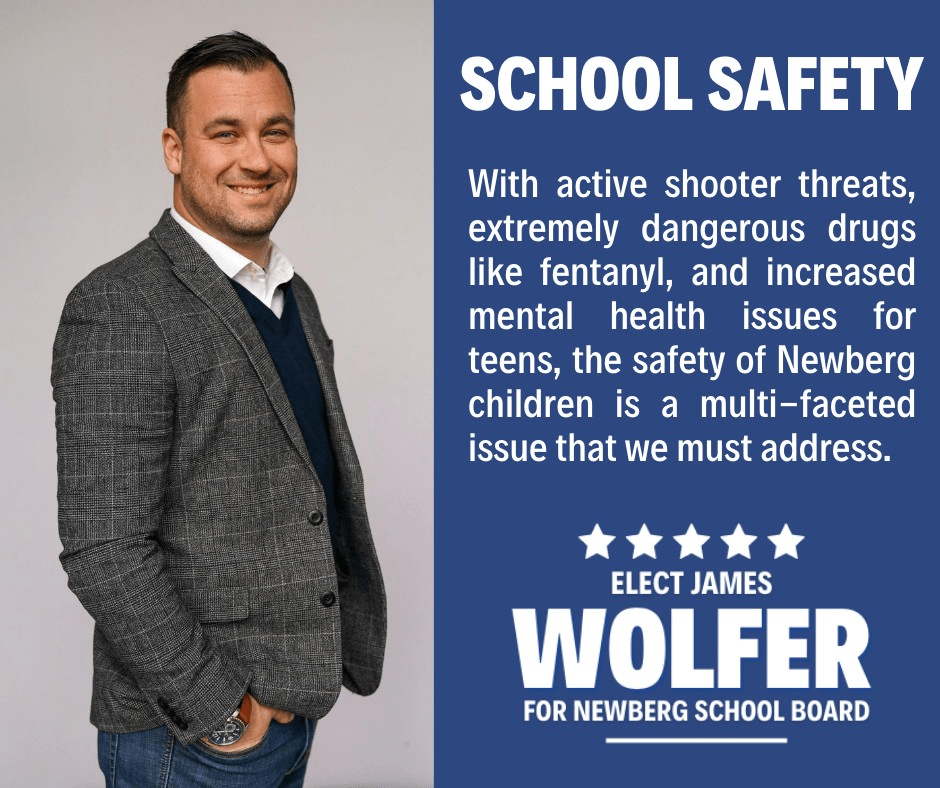
Today’s post is about a difficult subject: the physical safety of our public school students. It is written by James Wolfer, who is running against current board chair Dave Brown in school zone 6.

A little bit about James: He is a father, School Resource Officer, and Coast Guard Reservist. He is a Newberg native, graduating from both NHS and George Fox University.

To follow James:

Website | Email: teamjames@jameswolfer.com

2,067 miles separate Newberg and Uvalde, TX. Last year’s school shooting at Robb Elementary School in Uvalde was incredibly upsetting to me not only as a parent, but also as a school resource officer. There were multiple abject failures leading to the tragic deaths of 19 students and 2 educators. The state of Texas passed school safety legislation in 2018 that collectively we saw was ineffective. Uvalde Consolidated Independent School District last updated their policies about threatening conduct and weapons in October 2021. The policy for threats to a school in Newberg hasn’t been updated by our school board since 2000. Since 2000, the Washington Post reports there have been 366 school shootings and 338,000 students impacted by gun violence at school.

Extremely dangerous drugs are flooding our communities and getting into our schools, increasing the risk of overdose deaths for students and staff. We need robust education on addiction, a policy basis for how to treat youth addiction in our schools, and naloxone (Narcan) in every school building.

Student mental health issues have become epidemic, with suicides and suicidal ideation touching every school district – Newberg in particular in recent years. Our schools have to invest in improvements to the mental health supports in Newberg schools to provide top-of-the-line interventions. Our schools must become expert on cultural competencies, provide trauma-informed care, and recognize additional supports that kids from historically-marginalized groups may need.

Safety is a complex issue. When we’re responsive to what our kids are going through, we can build policy to prevent the worst-case scenarios and create conditions where Newberg students not only survive, but thrive to become treasured adults in our community.

This is About Competence and Integrity, Not Politics

School boards should be non-partisan, including the one in Newberg.

Prominent voices in our community have made divisions regarding public education into a left versus right, progressive versus conservative fight. Those opposed to the school board’s actions are regularly called sore losers who don’t have children’s best interests in mind; those critical of the Newberg School Board have been accused of being leftist shills, wanting to indoctrinate children.

This is a misrepresentation of concerns from those who oppose the current school board and its policies. 

In 2021, a Save Our Schools slate altered the school board’s make-up. School board elections were historically non-partisan and, in fact, the board pre-2021 had several conservative-leaning members among its numbers, people who voted in the interest of students and educators, and acted with integrity and transparency in their decision making. 

Our concern is not about the lack of progressives on the board.

It’s the lack of transparency. 

It’s the lack of accountability. 

It’s the lack of a willingness to listen to educators’ needs, and to parents who aren’t sufficiently loyal to the school board and its decision-making.

In this space, we plan to highlight the difference between a functioning school board and one that has ceased to function effectively. We want to note these differences not to score political points, but to show that our concerns are about Newberg’s children and their educational future.  

This week on What Should Happen with a Functioning Board: Board Committees

Here are the committees that should be meeting regularly when a school board is functioning normally:

  • Personnel Committee: should be working on the superintendent evaluation.
  • Facilities Committee: should be working on a long range plan to figure out the next bond/levy needs, deferred repairs, etc.
  • Policy Committee: should be regularly reviewing law changes which require updates to policies. This board stopped a complete review/rewrite of Board policies in June of 2021 before it was complete. The most important (and largest) section of policies regarding students has not been reviewed for compliance with the law or had any updates for any law changes since 2021.

If you scour the Newberg School Board website, or look for any information about board committees, you will find information about these committees meeting:

[Nothing]

Like we said, our concern is about competence, not politics.

How can you help?

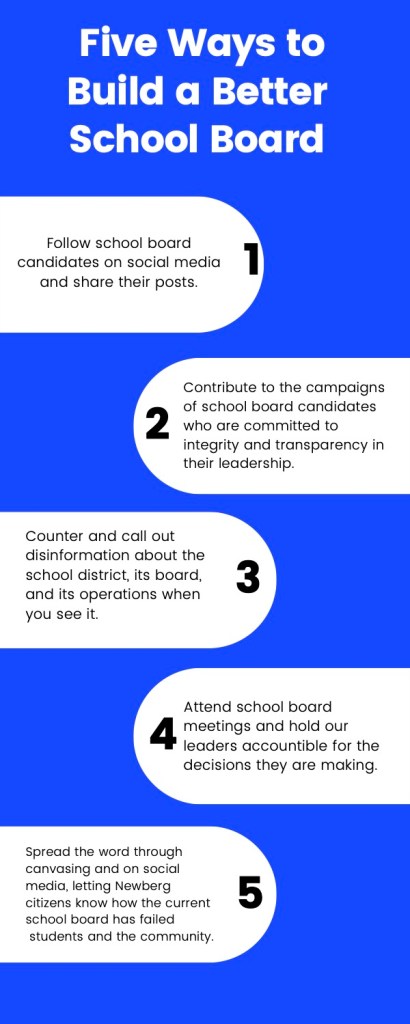
Although school board elections are only a few months away, your actions right now can help to assure that the Newberg School District gets back on track. The issues in our district—and with our school board—might seem overwhelming. Working together and taking these simple steps will help assure a brighter future for our community.

Follow candidates on social media and advocate for their platforms. Their social media also has links to candidate websites with more information on their platforms.

 Finding ways to advocate for these candidates will give them and their student-first platforms added visibility, assuring that the current school board will not remain in power.

Contribute to their campaigns. Political campaigns, even for local, non-partisan elections, cost money. Some school board members were elected through a windfall of election money from political groups that have little interest in Newberg or its programs. Every small contribution to a candidate can provide a counterbalance to this outside money.

Counter disinformation when you see it (with a caveat). We’ve all seen the disinformation on social media: praise for the current school board, deflections away from their unethical acts, the defamation and name-calling of those of us who oppose the current school board. Countering the disinformation with factual evidence is important, though keep your own mental and emotional health (and physical safety!) in the forefront. The biggest name-calling bullies in Newberg will not be swayed from their narrow-minded rhetoric.

Personally attend school board meetings, as a way to hold them accountable. If you’ve attended any school board meetings recently, you know that the atmosphere is charged. The school board has rallied its supporters, many without children in the district, to cheer on their work. Attending school board meetings offers a counterbalance, letting the current board know that they can be held accountable for their decisions.

Spread the word through canvassing and on social media: the current school board has failed its students. The school board has cratered a once-vibrant district. Over 100 talented educators have left for other districts where their work is supported. The board’s decisions cost the Newberg taxpayers close to a half-million dollars (and counting!) in legal fees. Graduation rates are lower, and popular programs, like music and art, are being cut. Although the school board continues to blame the previous board, the pandemic, the state of education, what they are doing is not normal. We need to get the word out about the ways this school board has specifically failed us.

 Newberg deserves better.

Mission Statement

Newberg Neighbors for a Better School Board is deeply committed to our public school system. We want every student in the Newberg School District to receive a high-quality education, and know that the current school board is unable to deliver the education families in Newberg deserve.

Newberg Neighbors for a Better School Board is committed to assuring that the Newberg School Board is professional, fiscally responsible, accountable to the public, and accessible to all families in the district. Right now, the Newberg School Board has failed to follow professional standards. Its decisions have cost the district extraordinary amounts of money that might have served our students well. It has not been accountable to the public, and its decisions have not been communicated clearly-with clear rationale-to families in our district.

Newberg Neighbors for a Better School Board is committed to representing and welcoming a diverse student body and staff. Until school board elections in May, we will communicate clearly about how the school board’s actions have been detrimental to our community, knowing change needs to be made so that everyone- families, educators, the Newberg/Dundee community-can regain trust in our schools.

Join our Facebook page and follow our blog as we address concerns about the current Newberg School Board. Together, we have the power to create a community where:

  • People matter more than politics.
  • Transparency and accountability matter.
  • Neighbors learn to trust each other again.

Blog at WordPress.com.

Up ↑