

Things Are Worse Than We Thought – Part 4

Board Pushes Family From Newberg

Since the school board election in 2021 and the beginning of Dave Brown’s tenure as board chair, more than 230 students have left the Newberg-Dundee School District. This translates to over 2 million dollars in lost funding. Incumbent board members will be quick to point out that families leave the district for all kinds of reasons, and the school board cannot be blamed for a mass exodus of students. (This was not something they argued, I might add, when the previous superintendent was in place.) They might argue that nearby districts have also lost students, though data does not support this claim. A few board supporters will insist that parents left the district because their kids were being brainwashed by liberal teachers, with assurances that re-electing a “conservative” board keeps schools from becoming  “indoctrination centers” (in the words of Board Chair Dave Brown).

We interviewed a parent to give some perspective that might help us understand why families are leaving the district. Spoiler alert: Many are definitely leaving the district because of the current board, taking their deep investment in Newberg and its schools with them. They leave because they value their children’s education. They leave because they value educators. 

They leave because they believe in public education, but worry that the dismantling of Newberg schools might negatively affect their children’s futures. 

Let’s call this parent Jamie. Why did you leave?

“We had to think about our kids’ futures. Things start to matter as kids get older. The ship is sinking, and we don’t have time to wait around for the ship to right itself,” they added, explaining why their family has moved to a nearby town so that their children can attend flourishing schools.

“If a college admissions board googled Newberg now, the results would not be good,” Jamie said, noting that a competitive college admissions process might mean Newberg students are at a disadvantage. 

During our interview, Jamie reiterated several times that they don’t blame educators. In fact, they were appalled that during the last superintendent search, the educators’ clear choice wasn’t hired by the board. Why would the board make the deliberate decision to turn away from a superintendent candidate who was well-liked by teachers, and who promised to bring unity and stability to the district?

Jamie knows Newberg’s educators. While their children attended Newberg schools, they worked closely with teachers, participated on the volunteer board, sent out monthly newsletters to a school’s parents, helped with fundraising, and was “super involved with teachers” to help foster a strong connection between parents, educators, and the community. 

Their kids were also very invested, participating in “all the activities possible,” including representing Newberg in state and regional competitions. “They were very engaged in school,” Jamie said. “We never imagined that this would happen” to the community. 

“We were very happy until the craziness started,” they said. 

The parent pointed out that the mass exodus of educators and students causes a “ripple effect” in a community like Newberg. “It’s so important to have stability in the district,” they said, noting the particular impact of nearly 200 educators leaving the district. “Losing institutional knowledge is devastating.”

When the board’s mantra is “focusing on the basics” in education to the exclusion of social and emotional learning, they will produce young people who cannot navigate college or career, whatever pathway students choose.

“When I hear them talk about getting back to the basics, I wonder whether people are even working in the world!” Jamie said. “Job interview questions are all about social and emotional learning: being team players, critical thinking, and working with the opposition. To participate in the world economy, students need to be competitive: they need to be articulate, and have good critical thinking skills, not just be able to memorize facts.”

Jamie’s whole family is sad to have moved on to another district, because of the community they’ve lost; though they’ve found a “stable district” that’s supportive of teachers and students. 

“This year has been refreshing,” they added. “No matter what side of the fence you’re on, it’s troubling that there’s always angst, that the teachers aren’t supported.”

The sobering reality is that a generation of children may find their futures compromised by a school board’s decisions–decisions that have gutted a once-flourishing district. 

At the April 11, 2023, board meeting, Director Trevor Dehart said “based on my discussions and what I know about the district, we’re in a very very healthy state.” Judging by this parent’s experience, the experience of teachers and staff, and that of countless others in the district, Dehart does not know what he’s talking about. Instead, the district is flailing, failing its teachers, its families, and most importantly, its children. 

On May 16, we have the chance to stem the bleeding of students and staff.  We have a chance to support the passion and dedication of educators. A vote for Jeremy Hayden, Deb Bridges, Nancy Woodward, James Wolfer, and Sol Allen will help rebuild Newberg’s public schools into a place students, their families, and educators want to be.
NSD’s Open Forum: Transparency or a Campaign Event?

Transparency is one principle we’ve returned to often in writing about the current school board in Newberg, and the sense that board members are not being transparent with anyone but their ardent supporters. In the past two years, the board has not been transparent about a number of things, including the surprise no-cause firing of Superintendent Joe Morelock, the use of district funds to fight multiple lawsuits (and pay for attorney Ty Smith), the budgeting process, and the reasons why they’ve decided not to follow Oregon Department of Education policies. 

Recently, two major decisions—the start time for all schools, and the change to trimesters—happened without much community input, making some parents suspicious and edgy. What other decisions will be made by this board behind closed doors, decisions that could adversely impact Newberg families? Parents who love their children almost more than life itself have every reason to wonder what shoe will fall next, and how those decisions will impact their children’s educations, and thus their futures.

So forgive us for being somewhat distrustful of the recent announcement that the Newberg School District will have a community forum on May 3—a chance, the Facebook post says, for the district to dispel “misinformation pertaining to district programs and processes” about schools. A clear and transparent school board would have communicated with all parents throughout the year, not only in the weeks before an important election and six weeks before the school year ends. As it is, this forum feels more like a campaign opportunity for school board incumbents, rather than a sincere effort to create trust with constituents.

The district is requesting questions be submitted before the forum. On April 28, to be exact. Parents are warned that there can be no questions about district lawsuits or about “anything political.” We understand the need to refrain from talking about lawsuits, but how is the district leadership going to define “political”? 

Is asking a question about what services special education students aren’t getting political? Is it too political to wonder what professional development educators are getting, and whether Diversity, Equity, and Inclusion instruction is part of that development? Is it too political to wonder whether the board’s push for parents’ rights will mean that some parents’ rights matter more than the rights of other parents? 

If this was truly an open forum, one that prizes transparency, we would have a sense of what questions people were asking, and why some questions were considered political, while others were allowed to stand. As with other aspects of the current board, though, transparency only matters when the narrative being spun is not only positive, but also positively toxic. 

Chaos in the Nutrition Program

Some people might be wondering what’s going on in the Newberg Schools nutrition program. Wednesday afternoon, a number of parents received emails from the program suggesting that the students had a balance on their accounts, which was news to at least one parent whose kids haven’t been at Newberg schools this year. Others took to the district’s Facebook page to question why they received emails that seemed to be in error. 

Only days earlier, rumors circulated in Newberg that the school district would not be providing meals for children during the summer. For many parents, the summertime breakfast and lunch program means the difference between their children having food needs met and stretching an already margin-thin grocery budget even further. The program also has been one way for children and their parents to socialize during the summer months, a point of community contact that many people rely on.

So the news about a potential cancellation of the program was met with particular outrage, especially by parents who have seen their children lose out on so much already. The summer lunch program is federally-funded, although it’s administered by the school district, who pays for staff to make and distribute meals. Some wondered whether the district lacked the funds for the program because of the substantial increase in a legal budget needed to deal with costly lawsuits, and because the district has lost so much revenue from families leaving the schools.

By late in the day, the Newberg-Dundee Schools social media pages announced that lunches would be provided in the summer after all, no doubt convinced by a flurry of emails from upset parents. At the school board meeting on April 25, Superintendent Steve Phillips insisted that the summer lunch program was never in jeopardy, and that the rumors had been lies, though a few parents produced emails from the program suggesting that the program would not continue because Covid funds were no longer available. So lunches during the summer are on, though breakfasts are, for now, off the table. 

We might assume that this is just a bad week for the nutrition program, and that the disarray is recent. But, according to a former kitchen manager, the chaos actually started last summer, when the former Nutritional Services manager left the district because of the board’s toxicity. A new hire, someone the kitchen manager said was “AMAZING” (emphasis hers), lasted only two months before leaving for another district, too; according to our source, the supervisor was being “harrassed by the superintendent and HR director.” 

A third manager, Brian Quinn, was brought on board, and problems allegedly began almost immediately. “He doesn’t understand federal guidelines, and consistently broke ODE rules regarding serving,” they said. “He didn’t follow policies regarding student allergies . . . He wouldn’t post menus for students and parents to see. He wouldn’t provide recipes so the nutritional information was available.”

The Newberg Public Schools Facebook page publicized the “Tiger Bowls” on April 12 as a notable addition to its nutritional fare. But, according to the former employee, Quinn did not disclose the ingredients. Sauce for the Tiger Bowls used almonds, and a student allegedly suffered an allergic reaction as a result. 

The one-time kitchen manager left their post because of the stress caused by the nutrition department supervisor. “Most of the nutrition staff have gone to the union, gone to HR, reported him to ODE, reported him to Yamhill County Health (he has refused to show that he has a basic food handler’s card),” they wrote. “The administration (superintendent and HR director) REFUSE to do anything about the situation.” 

Of course, the problems in the nutrition department cannot be solely due to school board oversight (or lack thereof). But in a district already hemorrhaging students and employees; in a district beset by problems with transparency and accountability; in a district where thousands of dollars are being spent on legal fees while classrooms suffer, the mismanagement of the nutritional department is one more place where children ultimately lose. Some, like those with food allergies and those with food insecurities, will suffer most.

First Semester Numbers Paint a Bleak Picture

At the April 11, 2023, board meeting, Director Trevor DeHart used his comment time to provide appropriation for the board’s work in turning around what he saw as a failing district. According to DeHart, signs of the district being in a “great place” are everywhere: from the new construction, thanks to a bond (that passed when Joe Morelock was superintendent); to an improved system of communication and “healthier budget”; to enrollment numbers that are up, reflecting a flourishing district.

At least two times in his brief comments, DeHart said “if you’re honest with yourself,” suggesting that critics of the board need to look at the facts on the ground and see that the data proves the district’s positive trajectory. 

If you’re honest with yourself, though, you’ll see that DeHart is not telling the truth, not about the budget, not about the improved communications, and not about the data. In fact, according to the data, the district is losing students almost as quickly as employees.

Here’s the truth about enrollment numbers:

DeHart and others will note that the district exceeded its projection numbers by 200 students this past fall. But projecting student enrollment relies on prognostication, and doesn’t reflect the reality: that students are leaving the district at a rapid rate. Some props to Superintendent Phillips for correcting DeHart in the April 11 meeting, saying that those numbers only showed that the district exceeded projected numbers. 

What he didn’t say, and what DeHart didn’t seem to realize, is that between September 2022 and January 2023, at least 97 students left the district. (These numbers were uncovered in a FOIA request.) 

You can get a better sense of what this means by looking at the same time period for different years: 

9/17-1/18: -36

9/18-1/19: -29

9/19-1/20: +29

9/20-1/21: -26

9/21 – 1/22: -96

9/22-1/23: -97

Since the current board has taken charge, first semester leave numbers have almost tripled. (It’s interesting to note, too, that in the year before the pandemic, Newberg gained 29 students in its first semester.) 

It would be easy to excuse these numbers by insisting that things are bad everywhere; board supporters have been quick to say that the pandemic caused students to leave the schools, not only here, but elsewhere. And while the numbers don’t bear this out, it seems problematic–even hypocritical–to fire Morelock during Covid for what they argued was his failed leadership, but then assert that things were hard everywhere. If that truly was the case, what was the real reason for firing the superintendent? 

The first-semester enrollment numbers, and DeHart’s insistence that the data shows a healthy district, reflects a troubling pattern: information that might prove damning to the board is hidden, or misrepresented, or misused, forcing citizens to submit FOIA requests to find out answers. Or to become data analysts, to understand numbers that don’t really make sense. Or to feel as if they’re being gaslighted by a governing board to which they’ve entrusted the well-being of the people they value most: their children. 

If you’re honest with yourself, none of this makes sense.

What Fiscal Responsibility Looks Like

A voters’ pamphlet for the May 2023 election has been posted online, and will be headed to Oregon mailboxes soon. As you read through the stated goals for current Newberg School Board directors up for re-election, you will note they claim to support “fiscal responsibility.”  

But what does fiscal responsibility actually look like?

These board members will tell you that they righted a sinking ship–that it was only when they took over the board and fired Dr. Joe Morelock that Newberg found stable financial footing. We suspect they will use this year’s audit to support claims that the previous board and Dr. Morelock impoverished the district. 

Be wary of this smoke-and-mirrors attempt to position the current board as fiscally responsible, because the truth is a lot more complicated. Indeed, far from being responsible, the current board has cost the district plenty, and its decisions will continue to crater Newberg’s schools, leading to fewer programs, fewer talented teachers in the classroom, and fewer opportunities for Newberg’s children.

Gregg Koskela, who recently won a state-wide award as communications director for the Cascade School District, knows well the costs of the school board’s decisions, and understands clearly how a disastrous audit can be recast to hide the district’s financial precarity. Koskela was a longtime communications director for Newberg, as well as serving as point person for the bond, until he resigned last summer. 

In a well-researched and thoughtful blog post this weekend, Koskela clearly outlines the audit process, and explains why the board directors’ claims of “fiscal responsibility” is not reflected in the district’s real financial state. Koskela’s post offers just one more reason that the May 16 election matters to the flourishing of our school district and our school children, and to the future of Newberg itself.

You can read Koskela’s excellent blog post here

When An Apostrophe Means So Much More

In the 2021 Newberg school board elections, a consistent refrain was that new candidates needed to “Save Our Schools,” returning students to the basics of reading, writing, and mathematics. Newberg citizens were told that educators weren’t teaching kids, too focused on politics and indoctrination to care about educating. 

A new school board would “raise the academic bar for all students,” according to a candidate’s platform, articulated in the Yamhill County Voters’ Pamphlet. “Let’s expect more and lets deliver,” the candidate wrote, perhaps forgetting that a high academic bar would require that Newberg students write grammatically correct sentences. 

Sometimes, it seems, an apostrophe matters.

No doubt you’ve seen the signs currently around Newberg, promoting a block of candidates for this May’s school board election, but using an apostrophe incorrectly (unless, of course, there really is only one parent in Newberg intending to vote for Chairperson Dave Brown and the other four candidates). 

It might seem pedantic and petty to point out this error, a simple typographic mistake we are all in danger of making now and then. But when a block of school board candidates are arguing that our students need to achieve more academically, and when these candidates insist that they are first and foremost about reading, writing, and arithmetic, then a misplaced apostrophe on numerous signs spread throughout the region really does matter. 

According to the Oregon Standard for English Language Arts, students learn the appropriate use for apostrophes in the second grade (page 17 outlines this standard). Of course, any high school language arts teacher will tell you that writers continue to struggle with the conventional English standards until they graduate, usually because they have failed to internalize the rules, because they are careless, or because they don’t edit well, if at all.

It’s also not entirely clear whether the school’s current communications team has not yet internalized the rules of Standard English, if they are careless, or if they don’t edit well. Bridge and Bolster LLC, which essentially received a no-bid contract in August 2022 to run the district’s communications department, consistently makes errors in its documents, from misplaced apostrophes to misspelled words to wrongly-identified employees in social media posts. As one district parent recently asked, “at what point will parents be frustrated enough to expect 7k worth of work?”

The parent went on to say that she has spoken privately with Bridge and Bolster, suggesting they do a closer edit, and several others on the Facebook post also mentioned discussions with the marketing firm, asking them to be more accountable for the taxpayer money they receive each month by communicating more clearly with their constituents. An educational enterprise having so many errors in their communications is embarrassing, a number of people have noted, especially when some of the students served by the district could provide stronger writing and editing skills.

Bridge and Bolster became a company only seven days before starting with the Newberg School District; you can read about its controversial hiring here. Its owners had zero experience providing direction and expertise for a complex communications department, one that needs to produce clear information to numerous constituents and through multiple channels. A district already in disarray needed professionals who can write clearly and correctly, and who can do far more than post on social media and shoot promotional videos for the district office.  

As one former educator said, “I’m more upset that most posts are about the adults in the district, instead of focusing on students, volunteers, academic scores or plans to move our schools and students in a strong direction. We are paying $84,000 that does nothing to inform parents of how our schools are educating our students and preparing them for life after high school.” 

A strong school district has an experienced communications team, connecting with parents in the district and celebrating the academic accomplishments of its students. A strong school board doesn’t need its district communication team cheerleading its efforts, because its hard work will be manifest in the success of its students. A strong school board will be transparent about who it hires–and about why an inexperienced marketing firm received a lucrative contract. 

A strong school board will be accountable, transparent, and competent, aware that even an apostrophe can be the difference between a parent’s choice, and parents’ decisions to vote for candidates that can serve the district well. 

The Problem with Timing (and with Start Times)

The first day of Newberg’s spring break brought with it several surprises: a skiff of snow on roads and yards, definitely unusual in late March. There was also an announcement from Newberg Public Schools: start times for the elementary, middle, and high schools would be earlier next year. 

For this current school board, the confusing nature of the announcement and the lack of transparency about how the decision was made is definitely not unusual. 

Actually, the district made its announcement just before 5 p.m. on Friday, letting parents know on their Facebook and Instagram pages about the change. The backlash was almost immediate: two days later, almost 240 comments have been made on the Facebook page alone, many of them by angry parents who feel left out of the decision-making process–parents for whom even a 20 minute shift in start times will mean disruptions for their children. 

The Newberg School District policy is clear: the superintendent is well within his right to make a decision about start times unilaterally, without the feedback of educators, parents, or even the school board. Yet for a superintendent and board who seem focused on parents’ rights, and who fashion themselves as “the parent’s (sic) choice” (at least according to campaign material), the lack of transparency about the change is troubling, especially when compared to past boards and past superintendents.

Ahead of proposed start time changes in 2021-22, the school board convened an ad-hoc committee: to study the data; comb through research on what early start times mean for younger children as well as teens; get feedback from the community; and make a recommendation to the school board for approval (even though, again, then-Superintendent Joe Morelock could have made a unilateral decision). 

If you look at meeting minutes from January 12, 2021, you can see their robust report, including links to research about sleep and mental health, as well as an explanation of scientific research on start times (the report starts on page 31 of an extensive board packet). The ad-hoc committee also met with community members on January 5, 2021, as well as compiling data from a survey sent to all parents in the district. In March of that year, Superintendent Morelock provided a final report to all families in the district, preparing them for the announcement about new start times.

This weekend, on the school district’s Facebook page, parents feared that a decision was made without their input, especially given the extraordinary hardship an earlier start and release time might have for working families and for children’s time with parents at home. In some comments, parents reflected on the struggle their children are already experiencing with early start times, and their concerns about kids waiting for buses in winter morning darkness. A number of parents asked Had anyone asked parents about how the changes would impact them? 

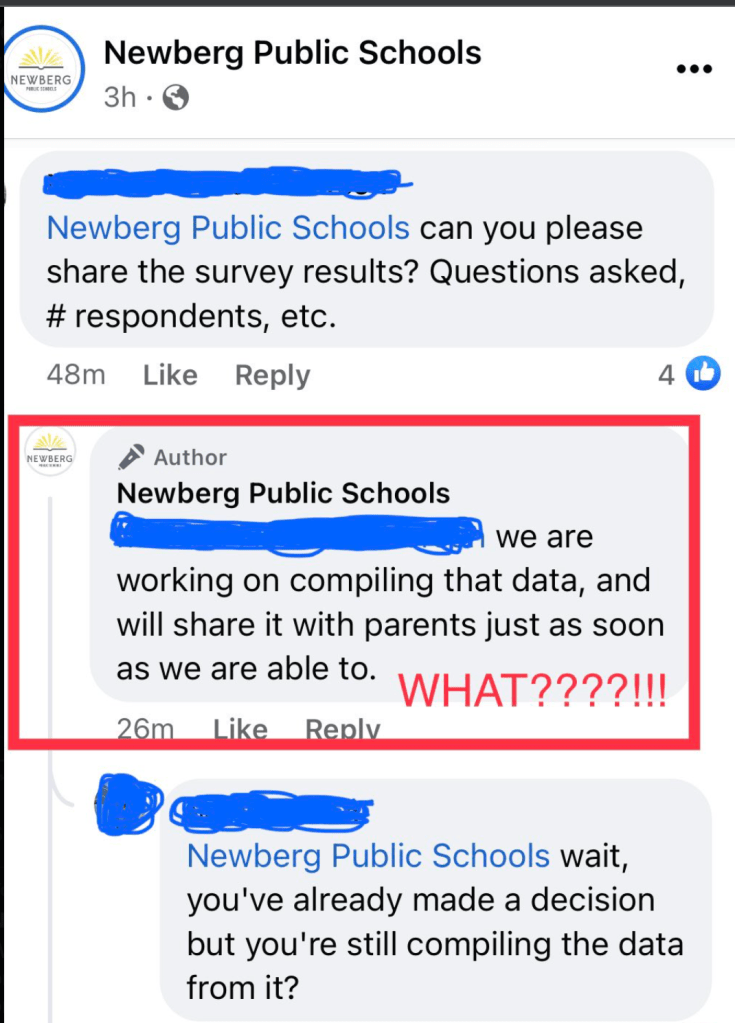
Apparently high school parents were surveyed near the last day of school in June 2022, but younger parents were not asked for feedback. Since then, there has been no follow up about how that survey data was used. Questions on the post about the lack of feedback regarding the school district announcement were met with confusing responses. 

One response from the school communication team noted the district was still compiling data, and thus couldn’t share it yet; but then, in subsequent responses, the same person said that the data had been compiled, but couldn’t yet be shared. Both answers were confusing, especially when the communications team seemed to be editing answers on the fly, making the decision seem even less informed.

A person who will no doubt be happy about the controversial decision is Chair Dave Brown, the self-appointed parent’s choice for reelection in Zone 6. In 2021, Brown tried to compel the board to choose earlier start times for high school students (and subsequently middle and elementary schools as well), despite overwhelming evidence that this change was unwanted by many parents and students in the district. His fundamental consideration seems to be high school athletes who might miss afternoon classes to travel to competitions, and whose practices would be affected by a later dismissal time.

The meeting minutes leading up to the decision in 2021 show in stark relief the one-time transparency of Newberg’s school boards, their integrity in communicating with the public, and their desire to make sure that all Newberg students were well served by the policies they created, including start and dismissal times for all schools.

Announcing an unpopular decision right before spring break is problematic. Being unwilling–and unable–to explain the data that informed the decision is also troubling. Refusing to consider the science of children and sleep, including studies released in the Newberg schools’ own report just two years ago, makes it difficult to understand why the change needed to be made at all. Except, maybe, for the benefit of Coach Brown. 

As we’ve said, the election on May 16 is about transparency and integrity and doing what’s best for students. But like snow falling on the first day of spring break, the decision about start times was not welcomed, not needed, and left huge parts of Newberg feeling left out in the cold.

Here, Right Matters

With Newberg’s school board elections less than two months away, the division and rancor in our community continues to build. James Wolfer’s decision to stop his campaign for Zone 6 board director this week, citing harassment at his job, highlights the attempts to silence people in Newberg who speak truth to power. 

We want to support Wolfer in his efforts to protect his family and his livelihood. We also want to grieve that this is what our community has become, where someone volunteering for a nonpartisan position in the Newberg school district can find his integrity as a police officer questioned, forcing him to make an untenable decision. 

In our sadness, it’s easy to give way to despair, deciding that the turmoil in Newberg will always be this way, or that we should use the same tactics of harassment and provocation that have been used to silence people in Newberg. It’s important to remember, in these moments, that in the words of Alexander Vindman, “here, right matters.” 

Here, right matters in an election that is not about progressive or conservative ideals, but about accountability, transparency, and competence, qualities to which we should all aspire, no matter our political leanings.

Here, right matters when fear-mongering about educators and about schools sows distrust in our teachers and the hard work they do. 

Here, right matters when board members claim to be “the parent’s choice,” even though a substantial number of parents do not choose a board director who seeks to silence them.

Here, right matters, and so we will continue to focus on what matters most in this election season: Accountability, transparency, and competence. Responding to harassment and smear campaigns by speaking truth to power. 

And also, voting for #JamesAnyway, who is the choice of this–and many, many other–parents.*

*Because James Wolfer’s name will continue to be on the ballot, voting for him rather than his opponent will send a strong message and, should Wolfer win, a replacement can be seated by the newly-elected board.

Millions in Funding at Stake: Will You Weigh In?

The Newberg School Board will hold its next meeting tomorrow, and according to the board agenda, there will be a discussion about “SIA.” The good news? The agenda suggests the discussion is “open for comments,” presumably from the public.

The bad news? The school board has yet to inform the public about what SIA is, how it impacts the school district, whether the board has even created a SIA plan, and what that plan looks like. 

Which raises the question: How will people be able to make comments, if they have been given no information about the initiative and the district’s plans for up to $5 million (or more) of funding SIA might provide?  

A bit of history: The Student Investment Account (SIA) funds are non-competitive grants available to all Oregon school districts. K-12 education funding in Oregon comes from state income taxes, lottery funds, property taxes, and federal funds. SIA funds fall under the Student Success Act (2019), which added $1 billion in funding per year for Oregon schools and students. According to the Oregon Education Association website, “This money could be used for  additional instructional time, providing mental and behavioral health supports, reducing class size, implementing a more well-rounded education, fully funding High School Success (Measure 98), improving school safety and more.”

In past applications, Newberg has allotted its SIA funds for reading specialists, behavioral counselors, drug/alcohol counselors, and other learning support efforts. (You can read past applications here.) Given this board’s lack of transparency and its inability to follow well-established OSBA policies, it’s not clear whether Newberg schools will receive this money. Given how strapped the district is financially, and the rumored cuts to important programs, it seems like leaving millions on the table would not be the best idea. 

The application itself requires significant community engagement, but the Newberg School District has offered no forums for engagement, beyond empathy interviews and youth surveys which were not rigorous nor equitable, and assuredly did not include representative populations that will be most served by SIA money: Spanish-speaking, special education, economically disadvantaged, and migrant families. For a board intent on providing “parents’ rights,” parents representing these groups have not been contacted, their needs not inventoried, in any systematic ways.  The law which created the SIA funds requires school districts to use public input to create their plans, and school boards to provide a place and time for public comment on the district’s SIA plan. But there is no plan available on which the public can comment. By now, the board should have at least posted their application online and have a paper copy available at the district office for people to review. There should have been at least one, if not two, presentations to the board about the SIA application, and an opportunity for parents to provide input before a final draft is due to the state by March 31. 

Now, the school board is asking for comments on an application no one has seen. There will be no opportunities to consider revisions to an application, if the community makes comments. With the application due at the end of March, and no more meetings scheduled this month, the community will have no idea what the final application looks like.

By way of comparison, Sherwood schools presented the first read of their SIA application in January, with the report and budget posted, and opened for public comments. Their budget is $5 million, and their planned apportion of the money is available on their website

It’s not clear why the Newberg school board has not followed a similar process, why they have not been transparent about the process they have followed, and why they are risking millions of dollars that might help those needing educational support in our district. Is this another example of incompetence? Are they refusing the money because of a politically-motivated attempt to cut ties with federal funding? 

As with many of the school board’s actions, this unwillingness to follow policy is baffling, especially with so much instructional  money on the line. 

So we want to know: will you weigh in? 

At the meeting tomorrow night, of course, but also at the May election. Because with millions of dollars potentially lost, our kids lose, too. 

Ethics Are Another Matter . . .

ACCOUNTABILITY

TRANSPARENCY

COMPETENCE

For the last two years, those who have opposed the Newberg School Board have argued for accountability, transparency, and competence in its operation. The firing of Dr. Joe Morelock at a November 9, 2021, meeting is emblematic of the board’s lack of accountability. Its lack of transparency. And its lack of competence, which led to multiple ethics violations. 

Finally, the Oregon Government Ethics Commission is taking notice.

The Newberg Graphic reported this week that the ethics commission has issued reports about the November 2021 meeting, affirming that the Newberg School Board violated state rules governing administrative boards when it chose to fire Dr. Morelock.

At the time, the board’s majority–Chair Dave Brown, Vice-Chair Brian Shannon, Trevor DeHart, and Renee Powell–failed to follow policies governing executive sessions, including notifying Morelock and other board members about the nature of the executive session. The three other board members, Rebecca Piros, Brandy Penner, and Ines Pina, were supposed to be notified alongside Morelock at least 24 hours in advance of the executive session, and were supposed to receive supporting material (including complaints made against Morelock) before the meeting.

Instead, the board majority violated Oregon administrative ethics by

  • Adding the executive meeting agenda at the last minute, notifying the board only 1.5 hours before the meeting and without supporting documents. (The rules dictate that notice needs to be given 24 hours in advance.)
  • Not telling three board members or Morelock what the nature of the executive meeting might be.
  • Failing to accommodate Piros’ visual impairment with material about the meeting that would help her participate (an ADA non-compliance violation).
  • Providing the board members with a packet containing the complaints regarding Morelock’s tenure as superintendent, and which presumably justified his firing.
  • Transgressing OAR 199-040-0030, which states that Morelock should have been given information about his termination and the complaints at least 24 hours, or one business day, prior to the executive session. 

The complaints themselves suggest the baselessness of Morelock’s firing, and were focused primarily on  vaccine mandates and why Morelock might refuse to apply the board’s flag ban. It was unclear how the complaints were gathered, or how Morelock himself was responsible to rectify them. You can read all the complaints in the complaint, including “Why have you let go of good substitute teachers that aren’t vaccinated but other school districts aren’t requiring vaccines?” and “Why don’t you have more control over your staff? They are out of control, and are not following policies/procedures.”

You can access the case information on the Oregon Government Ethics Commission here. The Newberg Graphic also covered the story here, although the heroic efforts of three board members–Piros, Penner, and Pina–is buried by the story’s lead. Each woman self-reported her attendance at the executive session at which Morelock was fired, making them complicit in the ethics violations. 

And still, they were left with an untenable choice that night. They could leave the meeting right away, well aware of the ethics violations. Or, they could stay at the executive session, knowing that they represented their constituents and that the wrongful termination of Morelock might jeopardize some students and educators they had been elected to represent. 

They chose to stay, even though that meant they would also face investigation by the ethics commission. 

In the end, Morelock was fired without cause, costing the district $175,000 in his salary for the year, plus another salary for the newly-hired superintendent. 

The four board members were not transparent about their actions on that night in November 2021 and now, over a year later, we finally know just how troubling Morelock’s firing was. Led by their chair and vice chair, the board acted in a way that was not transparent nor ethical. It could be that Brown and Shannon were merely incompetent when they failed to follow well-established policies, but either through incompetence or unethical behavior, they violated rules set in place for a reason. 

Does Newberg really want school board members who can’t model the kind of moral, competent, transparent leadership our children deserve? The election on May 16 should answer this question. 

Blog at WordPress.com.

Up ↑